Fiber Division
The Lenzing Group bundles its business activities in the area of regenerated cellulose fibers for textile and nonwoven applications in its Fiber Division.
Worldwide, Lenzing stands for the environmentally responsible production of premium and specialty fibers under the brands TENCEL™, LENZING™ ECOVERO™ and VEOCEL™.
With the clear positioning of the product brands TENCEL™ and LENZING™ ECOVERO™ for all specialties in the textile sector, VEOCEL™ for all specialties in the nonwovens sector and LENZING™ for all industrial applications as well as co-products, Lenzing successfully communicates its strengths. Sustainability combined with a high level of transparency and traceability, innovation, high quality for every application and strong brands represent Lenzing’s key differentiators.
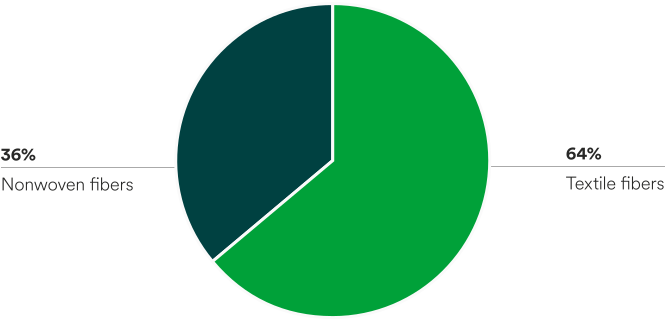
The Fiber Division’s revenue reached a level of EUR 1.9 bn in 2025 (2024: EUR 2.03 bn), 64 percent of which was attributable to textile fibers and 36 percent to nonwoven fibers. Fiber sales volumes decreased to approximately 904,000 tons (compared with approximately 960,000 tons in 2024).
Revenue split
Textiles and nonwoven fibers
The division’s earnings (EBITDA) amounted to EUR 0.1 mn, while the operating result (EBIT) amounted to minus EUR 184.4 mn. This result especially reflects the weaker second half of the year, with declines in both sales volumes and fiber prices.
Textile fibers
The market environment in the textile segment during the reporting period was characterized by subdued demand, particularly in the premium segment, as a consequence of uncertainties triggered by unstable tariff conditions and geopolitical conflicts. In addition to lower dissolving wood pulp and production costs, this had a negative impact on the price trend for textile fibers. Lenzing defended a stable price premium for its specialty fibers under the TENCEL™ and LENZING™ ECOVERO™ brands compared to commodity fibers, although prices for Lenzing fibers declined also over the course of the year.
Lenzing was affected by the generally subdued consumer climate, particularly in the second half of the year, through weaker demand for its premium fibers. China, Turkey, India, Pakistan and Bangladesh continued to be the most important direct sales markets for Lenzing textile fibers in 2025.
Lenzing stood out in particular for its quality, customer focus in processing and development of innovative applications, strong innovative capabilities and fully documented and audited sustainability. In addition, the premiumisation strategy was further advanced in high-margin market segments.
In the textile fibers segment, the new fiber type TENCEL™ Lyocell – HV100 was launched on the market in 2025. Thanks to the innovative Variocut technology, this fiber features controlled variations in fiber length, mimicking the fiber length distribution found in natural fibers such as cotton. This enables fabrics with a unique, structured look and feel – the result resembles traditional natural fibers while offering all the ecological benefits of TENCEL™ lyocell. The fiber feels soft yet more structured and was used for the first time, ideally, in premium denim fabrics. Its potential is enormous: from 2026 onwards, TENCEL™ Lyocell – HV100 will also be used in woven apparel and home textiles, in creative designs and in new material combinations.
Fibers from Lenzing are suitable not only for the production of yarns and, subsequently, textile fabrics, but also for so-called filling applications. During the reporting period, the LENZING™ Lyocell Fill product group expanded the fiber portfolio to offer greater comfort, resource efficiency and design diversity. These filling fibers provide not only improved thermal comfort and moisture regulation, but also shape-stabilizing properties. With two different linear densities and various cut lengths, the expanded fiber portfolio offers improved compatibility, allowing seamless blending with other filling fibers such as polyester and filling materials such as down.
Lenzing also expanded its portfolio of Lyocell Low Fibrillation (LF) fibers. These fibers are less prone to fibrillation and were developed specifically for use in knitwear. With its expanded fiber portfolio, Lenzing can now serve additional textile applications with its Lyocell LF fibers.
Lenzing has developed a biodegradable, market-ready alternative to conventional plastics in partnership with Swiss company OceanSafe. This collaboration combines Lenzing’s TENCEL™ Lyocell A100 fibers, which are naturally soft cellulose fibers, with OceanSafe’s naNea, a high-performance biodegradable co-polyester. The aim is to develop yarns and fabrics that combine comfort and durability on the one hand with genuine circularity on the other. Together, the partners aim to bring scalable, innovative and sustainable textile solutions for fashion and functional apparel to market. The newly developed yarn has already been used in a capsule collection for sportswear.
Lenzing enhanced the visibility and brand awareness of its TENCEL™ and LENZING™ ECOVERO™ brands thanks to successful digital marketing and PR initiatives, generating more than 306 bn PR impressions worldwide, while social media impressions exceeded 180 mn and more than 37 mn digital interactions were recorded.
The success of the TENCEL™ and LENZING™ ECOVERO™ brands in the 2025 financial year is also reflected in the strong engagement of their partners: around 2,500 partners requested product licenses as well as marketing materials from Lenzing. This momentum is being further strengthened through collaborations with global brand partners. These include both established international and emerging brands such as Levi’s, H&M, COS, DVF (Diane von Fürstenberg), Jack & Jones, Armedangels, GANNI, Guess, Carhartt, Marc O’Polo, AKYN, MUD Jeans, Camper, Next, Stripe & Stare, FatFace, The White Company, Circle Sportswear, Boden, La Maison Simons, Aritzia, American Eagle, Reformation, GAP, AllSaints, Anta, Aimer, Insider, C&A, DOD, Aluf, Neriage, DAGI, Jimmy Key, Mavi, Yamamay and Impetus. In addition, the TENCEL™ brand advanced designer partnerships with KNWLS, Patrick McDowell, Johannes Warnke and Reinaldo Lourenço.
In 2025, the TENCEL™ brand continued its strategic transformation under the brand manifesto “Nature. Future. Us.” and accelerated its premium positioning through compelling storytelling and product innovations. In cooperation with its partners, the TENCEL™ brand continues to drive brand growth, build trust and initiate change across the entire global textile value chain.
Nonwoven fibers
Nonwoven fibers are a strategic business segment for Lenzing that has grown over the years and will be expanded further in the future to meet growing demand for cellulose-based nonwoven fibers. In addition to the functional advantages of Lenzing’s fibers, this growth is also supported by the global fight against plastic pollution. This includes, among other initiatives, the European Union’s bioeconomy strategy, which aims to consolidate existing legislation (including the Single-Use Plastics Directive and the Packaging and Packaging Waste Regulation) under a single framework. UK legislation banning single-use plastics in wet wipes will further pave the way for a sustainable future and is expected to come into force in the United Kingdom in May/June 2027. In the USA, the Wipes Act was successfully passed by the House of Representatives and forwarded to the Senate in June 2025. This regulates the labelling of flushability for wet wipes, an important factor in distinguishing between non-flushable wipes and flushable, biodegradable alternatives that can be produced using Lenzing fibers.
At the end of 2025, Lenzing announced its decision to invest EUR 15 mn in expanding nonwoven fiber production capacities at its Lenzing site. The expansion will focus on VEOCEL™ Viscostar fibers with a trilobal cross-section, which are particularly suitable for feminine hygiene products due to their efficient absorbency, offering a sustainable alternative to synthetic fibers.
One innovation in the area of cleaning wipes are the newly developed VEOCEL™ Lyocell EC (Enhanced Cleaning) fibers, which were specifically designed for disinfection applications. Most disinfectant wipes are based on the active substance class of quaternary compounds (quats). These substances bind very strongly to cellulose fibers, in contrast to synthetic fibers. In practice, manufacturers of disinfectant wipes aim to achieve a consistent release of active ingredients and thereby low binding to the fiber surface. For this reason, a new type of lyocell fiber was developed that binds less strongly with quats and consequently enables a consistent release of active ingredients. The new VEOCEL™ Lyocell EC fiber has already been introduced at a major nonwovens industry conference.
The patented LENZING™ Nonwoven Technology produces lyocell filaments that are processed directly into a nonwoven material during the production process. The combination of the natural bonding of the filaments and subsequent hydroentanglement enables the manufacture of materials without the use of surface treatments or binders, thereby helping to reduce microplastics in wipes. The latest product that can be manufactured using this technology is LENZING™ DUAL WIPE. This innovative wipe combines two functional sides: a soft side for gentle cleaning and a rough side for stubborn dirt. It was presented for the first time at IDEA® 2025, a major event for the nonwovens industry in Miami, where it already attracted strong interest from the industry.
Through tailored innovation sessions, Lenzing strengthened its partnerships during the reporting year with twelve strategically important nonwovens customers, including Unicharm, Shinwa, BAT, Suominen, KC, Nitto, DAO, Convatec, Magnera, Solventum, Aralar, Albaad, Fibertex and Rockline. In addition, the cooperation with Carefree in North America was expanded. Following the successful market launch in the USA of panty liners made with VEOCEL™ lyocell fibers featuring Dry Technology, this product line was also launched on the Canadian market.
Co-products of fiber production
At all locations where the Lenzing Group produces viscose or modal fibers, the co‑products manufactured include LENZING™ Sodium Sulphate. This is used in the detergent and glass industries as well as in the production of food and animal feed. During the reporting period, Lenzing obtained ISO 22000:2018 certification for its co-product LENZING™ Sodium Sulphate. This is a globally recognized standard for food safety management systems. The sales volume of LENZING™ Sodium Sulphate recorded further year-on-year growth in 2025.