
Actions
[G1-3, MDR-A 68a]
List of key actions
Compliance Management System
Whistleblower system
Compliance training
Compliance cockpit
Compliance product safety
Global compliance risk assessment (Planned Actions)
For the key actions related to sourcing, please see the ”Sourcing” section in this chapter.
Compliance Management System
[G1-3 18a]
The objective in setting up and continuously developing the Compliance Management System is to prevent, detect and respond to compliance violations against the interests of the company, as well as to avoid liability risks and damage to the company’s reputation. Furthermore, the Compliance Management System aims to advise and safeguard the company’s management, executives and employees as well as to increase efficiency by coordinating existing compliance activities. The Compliance Management System corresponds to the following structure (figure Elements of the Lenzing Compliance Management System):
Elements of the Lenzing Compliance Management System
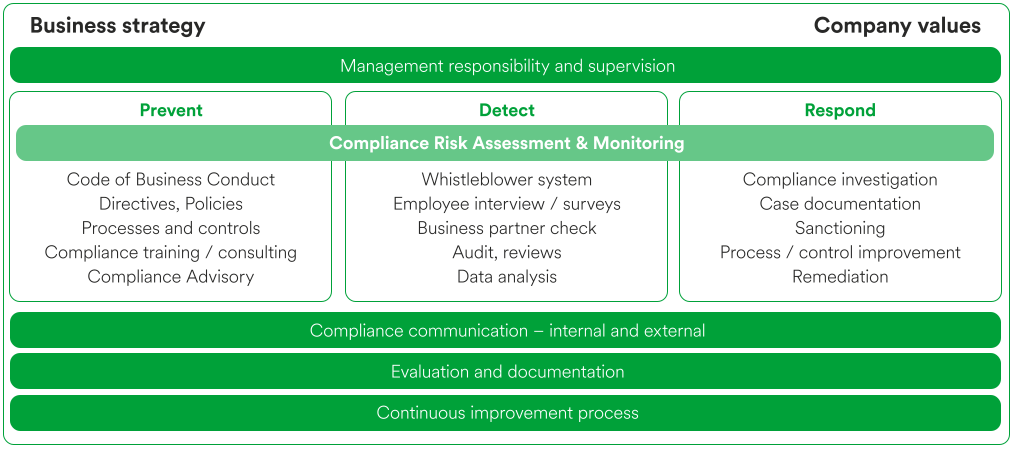
Formal structures, such as the assignment of responsibilities, ongoing monitoring and structures for communication, evaluation and documentation are essential components of the Compliance Management System. The ongoing compliance program is based on the following pillars:
Measures to prevent misconduct
Measures to detect compliance risks and weaknesses
Measures to respond to misconduct and identified weaknesses in order to avoid them in future.
Whistleblower system
[G1-3 18a]
To enable employees and external stakeholders to report concerns related to corruption, bribery, conflicts of interest, antitrust laws or capital market law, an online whistleblower system was established in 2017. For further details on the ongoing action (ESRS 2 MDR-A), please refer to the “Detective measures” (G1-1) section of this chapter.
Compliance training
[G1-1 10g, G1-3 18a, 21a, 21c, MDR-A 68b]
Understanding applicable rules and regulations is essential for responsible conduct. Hence, eLearning programs were further expanded during the reporting year to efficiently convey key compliance content to defined target groups. New employees receive onboarding material including the Lenzing Global Code of Business Conduct, and employees with IT access are assigned mandatory annual eLearning courses. Successful completion requires achieving at least 80 percent in the final assessment to ensure comprehension. Mandatory training topics for all employees, including the Managing Board, cover the Global Code of Business Conduct, the whistleblower system and know-how protection. In 2025, 87 percent of assigned employees completed the required eLearning modules based on 6,185 employees enrolled (2024: 89 percent). A small number of employees additionally receive in-person classroom training.
[G1-3 21a, 21b, 21c]
All white-collar employees and the Managing Board (2,661 employees) were assigned the mandatory ABC Directive training, of whom 95 percent completed the course (2024: 97 percent).
[G1-3 21a, 21b]
Specific trainings were provided to all identified functions-at-risk (100 percent). A total of 248 employees were required to complete the Antitrust training, with a completion rate of 92 percent (2024: 92 percent). The Anti-Money Laundering training was assigned to 326 employees with a completion rate of more than 85 percent (2024: 83 percent).
[G1-3 21a, 21c]
The Supervisory Board completed the e-Learnings Global Code of Business Conduct and ABC Directive trainings in 2025. The goal was to give them an understanding of their responsibilities in regard of overseeing the Managing Board’s implementation of compliance as well as of Lenzing’s values and corruption-related risks.
Compliance cockpit
[G1-3 18a, MDR-A 68a, 68b, 68c]
In 2025, the so-called Compliance Cockpit was globally implemented, as planned, to further strengthen business conduct management. The new system bundle includes the improvement of the whistleblower tool and the gift-and-hospitality tool. As well as the implementation of a conflict-of-interest registration tool and a policy manager for receiving, reading and acknowledging policies.
Compliance product safety
ISO 9001 certification
[MDR-A 68a, 68b]
An internal and external audit plan are executed to identify improvement opportunities and non-conformities that require corrective action. Thereby ensuring that Lenzing’s quality assurance system adequately supports the Product Safety Policy. The ultimate goal is to maintain valid certification for the Lenzing Group.
[MDR-A 68c]
In 2025, five out of nine sites were audited as part of the process to ensure all relevant sites are audited by 2027 and support the Lenzing Group’s ISO recertification.
3rd party product certifications
[MDR-A 68a, 68b, 68c]
The internal product testing plan and required recertifications were executed to ensure the product portfolio remains compliant to third-party certifications and associated high product safety standards. In 2025, the recertification of our fibers based on OEKO-TEX® STANDARD 100 was completed. In addition, the re-certification of 16 products with the food contact certification from ISEGA was completed.
Planned Actions
Global compliance risk assessment
[MDR-A 68a, 68b, 68c]
Lenzing planned to conduct a global compliance risk assessment as part of its monitoring activities. The assessment focuses on reviewing existing controls and identifying current and potential compliance risks with the aim of implementing targeted mitigation measures. The scope of the action covers all legal entities, and the assessment is expected to be conducted and finalized in the first half of 2026.
Update Anti-Bribery and Corruption (ABC) Directive and Anti Money Laundering (AML) Directive
[MDR-A 68a, 68b, 68c]
In 2026, Lenzing plans to update the ABC Directive and the AML Directive. Moreover, Lenzing also aims to strengthen its Compliance Management System by clearly defining core values and ensuring that appropriate mitigation measures are implemented in response to existing risks. These directives will apply to all Lenzing’s legal entities and are expected to be implemented by the beginning of 2027, after the Global compliance risk assessment has been concluded. In addition, the ABC Directive is planned to be formalized as a policy.