Value creation at the Lenzing Group
[SBM-1 40a i, ii]
The Lenzing Group is committed to ecologically and socially responsible fiber production based on renewable wood from sustainably forests and plantations. As an innovation leader, Lenzing partners with global textile and nonwovens manufacturers to drive technological developments across the industry.
Value chain
The Lenzing Group forms part of the chemical industry and serves the fiber market with regenerated cellulose fibers. Lenzing fibers are used primarily for clothing, home textiles, technical textiles, and hygiene products. Lenzing’s product portfolio also includes dissolving wood pulp, which is the basic raw material for producing fibers, innovative specialty fibers as well as energy, biobased biorefinery products, and co-products. The significant product groups according to ESRS are regenerated cellulose fibers and dissolving wood pulp.
[SBM-1 40f]
Lenzing combines comprehensive expertise in operating pulp and biorefinery processes with decades of experience in three major fiber process technologies:
Viscose (rayon)
Modal
Lyocell
Further developments and technologies have resulted from the above-mentioned processes. Lenzing’s significant products contribute to its sustainability targets. Please see the sustainability targets in the topical chapters.
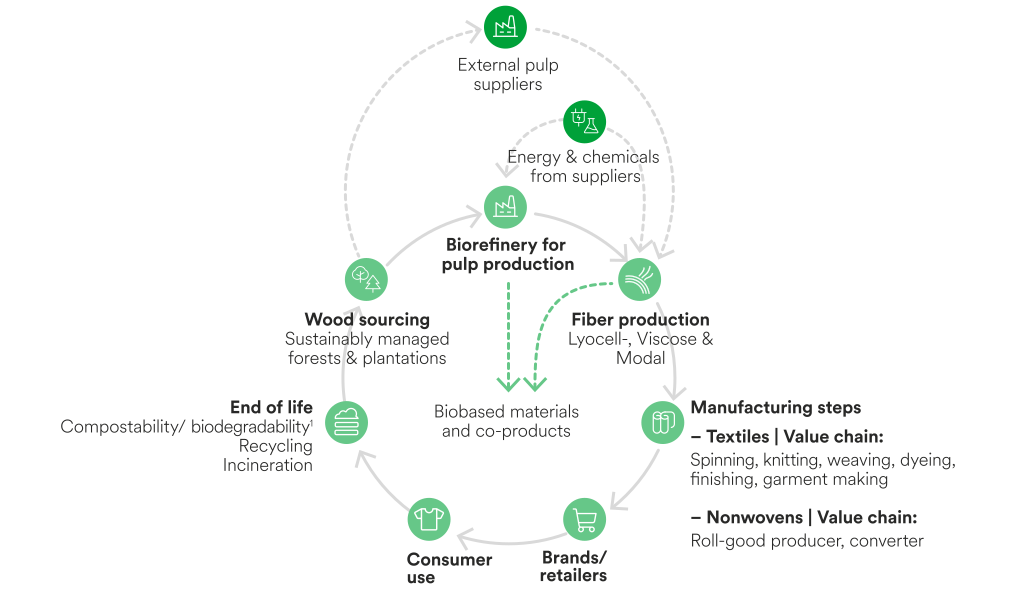
The Lenzing Group’s value chain is depicted in figure “Value chain” and described below.
[SBM-1 42a, 42c]
Supply and sourcing
The principal raw materials for producing Lenzing’s fibers are wood, dissolving wood pulp, process chemicals, water and energy. Lenzing secures these resources through strategic procurement contracts, such as sourcing wood mostly via long-term supply agreements. Lenzing also sources from its own plantations. Chemicals are predominantly sourced regionally to strengthen supply stability and reduce transport emissions.
Lenzing places a strong emphasis on sustainable and responsible sourcing. Supplier selection and evaluation follow defined economic, quality, environmental, social and governance (ESG) criteria.
The identified (potential) impacts, risks and opportunities in the upstream value chain primarily relate to the forestry and the chemical industry.
Dissolving wood pulp and cellulose fiber production
Production is realized in two sequential stages: firstly, dissolving wood pulp is manufactured; secondly, this pulp is processed into regenerated cellulose fibers. Lenzing produces its own dissolving wood pulp in three biorefineries located in Lenzing (Austria), Paskov (Czech Republic) and Indianópolis (Brazil) and manufactures fibers using viscose, modal and lyocell technologies across seven production sites.
Lenzing strives to apply state-of-the-art sustainable production technology characterized by high resource-efficiency, high chemical-recovery rates and, where possible, closed-loop processes for chemicals and water. The process also generates bioenergy, biorefinery products and additional co-products enhancing circularity and value creation. By combining deep expertise in pulp and biorefinery operations with decades of fiber production know-how, Lenzing operates as an integrated producer with a strong technological foundation.
Downstream manufacturing
As shown in figure “Value chain” under “Manufacturing steps”, customers in Lenzing’s downstream value chain process the fibers into textile, nonwoven and industrial products.
Lenzing works closely with partners along the value chain – from direct customers to retailers – to support fiber processing, enable innovation and jointly develop new applications.
The identified (potential) impacts, risks and opportunities across Lenzing’s downstream value chain relate primarily to processing steps in the textile and nonwovens industries.
Distribution and use phase
Finished products enter distribution channels after manufacturing and are then used by consumers.
End of life
TÜV certified LENZING™1 fibers are compostable and biodegradable under the right conditions. However, the end-of-life behavior of textile and nonwoven products depends on the material composition (e.g. fiber blends) and processing along the value chain such as dyeing and finishing, which may limit biodegradability or recycling options.
[SBM-1 40e]
For details on relevant geographies, stakeholders and products linked to sustainability targets, please refer to the target sections within the respective topical chapters.
Expected outcomes for customers, investors and nature
[SBM-1 42b]
Lenzing’s responsible practices and innovative products enable customers and value chain partners to achieve high product quality and functionality. They further support improvements in environmental and social performance, thereby supporting the fulfillment of their own sustainability targets and commitments.
Shareholders benefit from investing in a global leader in wood-based cellulose fibers and a recognized sustainability innovator operating in a structurally growing market for high-value premium products.
Nature is considered a silent stakeholder. Lenzing acknowledges its responsibility to advance sustainability performance in the textile and nonwovens industry and collaborates with NGOs and multi-stakeholder initiatives to help drive systemic transformation.
Revenue
[SBM-1 40b]
Information about Lenzing Group’s total revenue, disaggregated by its product groups fiber and pulp, can be found in the table “Revenue from external customers by products and services” in the financial Note 4 in the notes to the consolidated financial statements.
Employees
[SBM-1 40a iii]
Employees per country and in head count |
2025 |
2024 |
|---|---|---|
Total number of employees |
8,129 |
8,228 |
Austria |
3,418 |
3,511 |
Brazil |
1,282 |
1,236 |
Indonesia |
1,322 |
1,342 |
Czech Republic |
528 |
541 |
China |
802 |
816 |
USA |
201 |
212 |
UK |
227 |
225 |
Thailand |
276 |
269 |
Others (India, Türkiye, Korea, Singapore, Taiwan, Germany, Italy and France) |
73 |
76 |
1LENZING™ fibers which are TÜV certified biodegradable (soil, fresh water & marine) and compostable (home & industrial) include the following products: LENZING™ Viscose Standard textile/nonwovens, LENZING™ Lyocell Standard textile/nonwovens, LENZING™ Modal Standard textile, LENZING™ Lyocell Filament, LENZING™ Lyocell Dry and LENZING™ Nonwoven Technology. There is an exception for the TÜV certified biodegradable & compostable fiber LENZING™ Lyocell Filament, which fulfils the above-mentioned conditions except biodegradability in marine environments.