Governance
Governance structure
[GOV-1 22c ii]
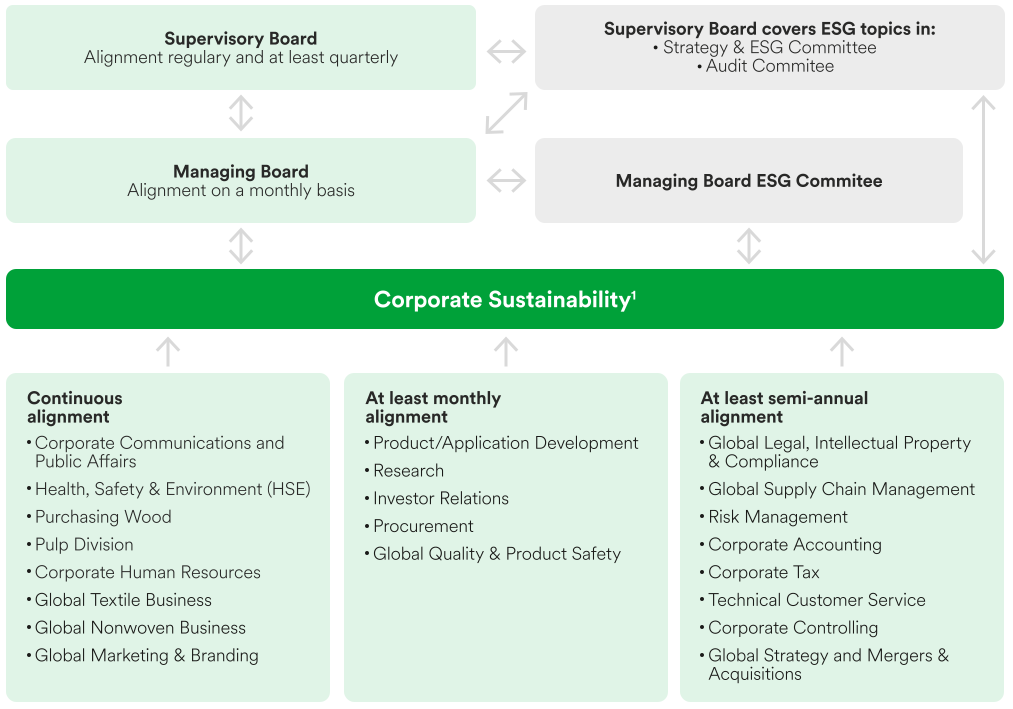
The Corporate Sustainability function reports directly to the Chief Executive Officer (CEO). To further embed sustainability within strategic decision-making, an internal ESG Committee at Managing Board level was established, which meets quarterly to monitor progress and steer key initiatives. Regular cross-functional alignment enables the systematic integration of environmental, social and governance matters into the company’s business strategy, risk management and operations.
Sustainability organization
Board Members’ expertise
[GOV-1 21c]
The composition of the Supervisory Board and the Managing Board collectively covers all critical expertise areas – sector and market knowledge as well as product- and sustainability-related competences. These include sustainable innovations, renewable raw materials, climate and energy, circular economy and recycling, biodiversity, water management, transparency, business ethics, fair labor practices, equity, diversity and inclusion. This wide range of experience ensures informed decision-making across strategic and operational ESG matters.
[GOV-1 23a]
Quarterly ESG committee meetings serve to continuously strengthen the Managing Board’s knowledge, skills and understanding of sustainability-related risks and opportunities as well as regulatory developments. This supports long-term strategic oversight and informed governance.
At Lenzing, the Managing Board and Supervisory Board are supported by the Corporate Sustainability department, which acts as the company’s center of excellence for sustainability-related matters. This department’s expertise is complemented by specialist experts from relevant functions across the organization, ensuring continuous access to technical and ESG knowledge.
[GOV-1 23b]
The specific knowledge of all experts is linked to the material topics that have been identified. This ensures that the leadership is well-equipped to oversee and manage sustainability matters effectively and that Lenzing’s material risks and opportunities can be addressed accordingly. By aligning sustainability efforts with the material topics, Lenzing is not only mitigating risks but also leveraging opportunities to create long-term business value.
Business conduct
[G1 ESRS 2 GOV-1]
Lenzing’s mission of compliance
Lenzing is a global company and acts in a compliant manner. The Compliance Management System forms an integral part of the Lenzing Group’s reporting system. The compliance function aims to advise and support all Lenzing employees, executives and managers through preventive risk-oriented measures. Additionally, it ensures consistent detection and response processes, ultimately protecting them from the negative consequences of violations of laws and values.
Lenzing’s compliance organization is transnational and composed of international experts led by the Group Compliance Officer, who reports directly to the Managing Board and the Supervisory Board. The Austrian Corporate Governance Code (ÖCGK) defines specific duties for the Managing Board, the Supervisory Board and the auditors. The overall responsibility for compliance lies with the Managing Board – it must ensure compliance with legal provisions and work towards their observance within the company (Section 15 ÖCGK). In addition, it must inform the Supervisory Board regularly, comprehensively and promptly concerning all issues relevant to the company and report at least once a year on anti-corruption measures (Section 18a ÖCGK). Lenzing expects its employees to comply with its rules of conduct. They are also required to be alert and to examine carefully and report any related issues that need to be addressed, or any violation of rules and values that are detected.
The Managing Board, the Supervisory Board and Lenzing’s employees take part in mandatory compliance training and are consequently well informed about business conduct matters. For more information about training, please see the “Compliance training” section (G1-3) in the “G1 Business conduct” chapter.
Composition and diversity of board members
[GOV-1 21a, 21b, 21d, 21e]
|
2025 |
2024 |
|---|---|---|
Number of individuals, total |
19 |
18 |
Under 30 years |
0 |
0 |
30–50 years |
4 |
2 |
Over 50 years |
15 |
16 |
Female |
2 |
2 |
Male |
17 |
16 |
Percentage of individuals |
|
|
Under 30 years |
0% |
0% |
30–50 years |
21% |
11% |
Over 50 years |
79% |
89% |
Female |
11% |
11% |
Male |
89% |
89% |
|
|
|
Ratio of female to male |
0.1 |
0.1 |
Managing Board (Executive members) |
4 |
4 |
Supervisory Board (Non-executive members) |
15 |
14 |
Representation by employees (Supervisory Board) |
5 |
5 |
Percentage of independent Supervisory Board members (acc. to the Austrian Code of Corporate Governance (ÖCGK) Appendix 1) |
100% |
100% |
Board’s responsibilities
[GOV-1 22a, 22b, 22c, 22c i]
The Managing Board is tasked with steering the company’s strategic direction and operational management. This includes overseeing the implementation of policies and procedures to manage material impacts, risks and opportunities. Each member has specific areas of responsibility. The Supervisory Board provides additional oversight and ensures that the Managing Board effectively identifies, evaluates and manages both risks and opportunities. The integration of ESG-related responsibilities is firmly embedded at board level. Committees of both the Managing Board and the Supervisory Board play a central role in exercising oversight over ESG management processes and strategic direction. For example, members of both bodies were actively involved in the double materiality assessment with the resultant findings subsequently being reviewed and discussed at board level.
On the Managing Board, Lenzing’s CEO Rohit Aggarwal was formally responsible for sustainability in 2025. Since February 2026, Georg Kasperkovitz has assumed responsibility for sustainability matters. For further information on the members of the Supervisory Board’s Strategy & ESG Committee and the Audit Committee – both of which address ESG topics through dedicated agenda items, please see the “Working procedures of the Supervisory Board” section in the Corporate Governance report.
Management of impacts, risks and opportunities
[GOV-1 22c iii]
The double materiality process, which forms the basis for sustainability reporting, is updated on an annual basis. The review draws on expert input and analysis across relevant subject areas. Where necessary, actions are defined and targets are set for specific material topics, if deemed necessary. Further information on target setting can be found in the “Sustainability targets” section of this chapter. Details on the management of risks and opportunities are provided in the “Risk management objectives” section in the Risk report. The majority of the material ESG-related risks and opportunities are already integrated into the risk management system, with additional emerging risks being incorporated on an ongoing basis.
ESG committee
[GOV-2 26a]
A Managing Board level ESG committee has been established to accelerate the implementation of the sustainability agenda by strengthening cross-functional alignment. The committee is responsible for shaping the sustainability strategy and overseeing the execution of ESG topics. It convenes quarterly and focuses on defining and advancing the company’s sustainability vision, strategy and ESG frameworks and tools. The ESG committee (figure “Managing Board ESG committee structure”) consists of the Managing Board and functional leaders. Together they monitor the progress on sustainability targets, evaluate the effectiveness of Lenzing’s approach to managing all aspects of sustainability, including risks and opportunities, and take long-term strategic decisions. The Corporate Sustainability department leads and forms an integral part of the committee. It collaborates closely with multiple business functions (see figure “Managing Board ESG committee structure”) to embed sustainability into core business processes, respond to stakeholder needs and expectations, and prepare the organization to be future-fit.
Oversight of ESG matters at Supervisory Board is exercised by the Strategy & ESG Committee and the Audit Committee, both of which monitor ESG matters in the context of strategic priorities and sustainable business performance. These committees are scheduled to meet at least twice a year.
[GOV-2 26b]
Decisions are based on a holistic perspective and cover a broad range of material topics as well as emerging issues, including opportunities, risks, current and future measures, sustainability targets, regulatory developments and stakeholder expectations. The impacts, risks, and opportunities (IROs) are taken into account when defining sustainability targets. Specific targets are established, approved, and regularly monitored by the Managing Board ESG Committee. In addition, ESG-related risks and opportunities are part of the company’s overall risk management.
[GOV-2 26c]
In 2025, the Managing Board and Supervisory Board addressed the following topics during committee meetings:
-
Climate strategy
-
Customer engagement
-
Sustainability target governance
-
Climate risk management, carbon footprint and LCA
-
Biodiversity approach and conservation projects
-
Industry ratings and benchmarks, such as the Carbon Disclosure Project (CDP) and Canopy ranking
-
Conservation solutions
-
Opportunities for differentiation
-
ESRS/CSRD-aligned non-financial reporting and double materiality
Managing Board ESG Committee structure
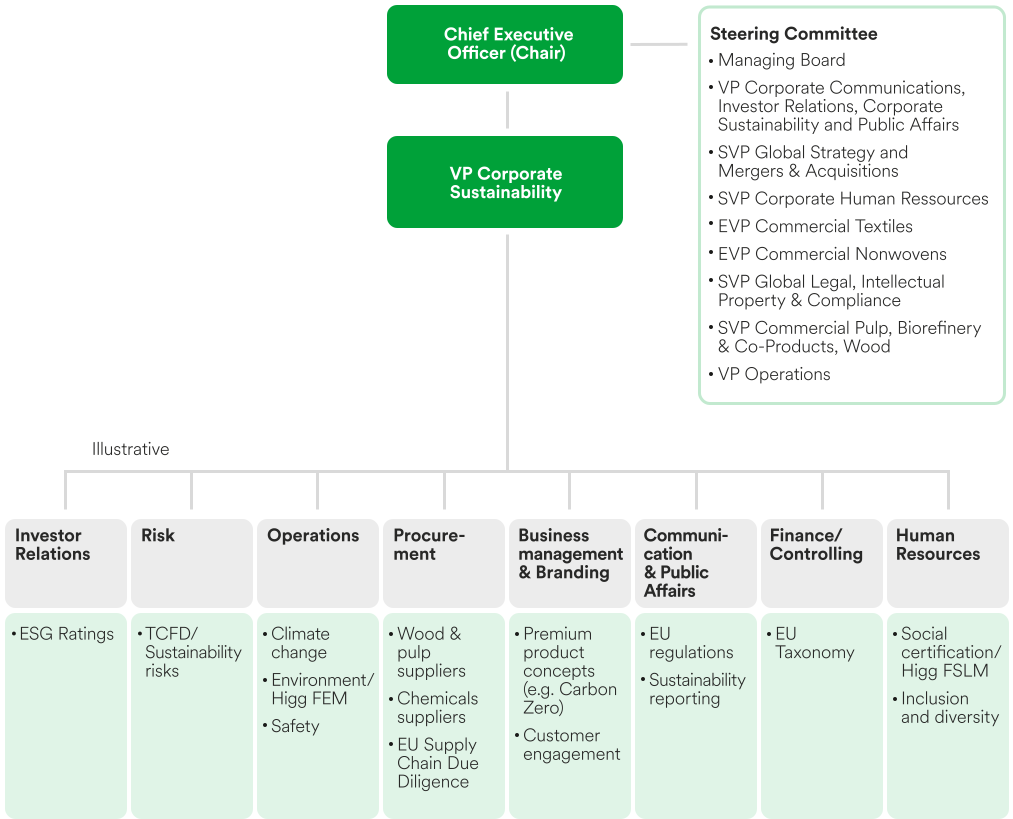
For information on the frequency of alignment of the administrative, management and supervisory bodies, please see the figure “Sustainability organization” in the “Governance structure” section of this chapter.
Board remuneration
[GOV-3 29a]
The Remuneration Policy of Lenzing AG for the performance-based remuneration of the Managing Board is linked to both financial performance and non-financial sustainability criteria (ESG), which further promote the integration of sustainability in the business strategy.
[GOV-3 29d]
Therefore, in addition to the existing criteria, the long-term incentive (LTI), which is a variable performance bonus, has been expanded to include sustainability targets for Managing Board members. Further information can be found in the remuneration reports (the report for 2025 will be available from March 24, 2026 onwards).
The proportion of variable remuneration linked to sustainability-related targets and/or impacts amounts to 6 to 10 percent for the Chairperson of the Managing Board and 4 to 7 percent for its members. There was no remuneration linked to sustainability in 2025, based on the 2023 tranche, as it was replaced by a special bonus.
[GOV-3 29e]
The remuneration of the Managing Board is approved and updated by the Remuneration Committee of the Supervisory Board.
[GOV-3 29b, 29c]
Specific targets and their metrics connected to the Board’s LTI remuneration for different three-year tranches are as follows:
-
“ZDHC lyocell” target: “To achieve ‘aspirational’ MMCF level for ZDHC wastewater and responsible production guidelines at Lenzing lyocell facilities by 2028”.
-
Linked remuneration target relating to the “Specific GHG emission intermediate target linked to corporate and remuneration targets”: “Lenzing reduces 45 percent of specific GHG emissions per ton of pulp and fiber produced by 2025”, as well as “Lenzing reduces 47 percent of specific GHG emissions per ton of pulp and fiber produced by 2026”.
-
Sub-target of “Textile recycling” target: “Innovating the use of at least 5 alternative feedstocks providers (e.g. from recycled textiles and agricultural waste) by 2030”.
-
Sub-target of “Equity, Diversity and Inclusion” target: “Lenzing increases its proportion of women to 22.5 percent in all positions graded 5a and above by 2025”.
-
Linked remuneration target relating to the “Equity, Diversity and Inclusion” target: “Lenzing achieves an improvement averaging three percentage points across the seven categories, including the Inclusion Index, in the global Health Climate Survey by 2026”.
-
“TRIFR” target: “To reduce the Total Recordable Injury Frequency Rate (TRIFR) to 0.8 by 2027.” (per 200,000 working hours).
Climate-related performance
[E1 ESRS 2 GOV-3 13]
The climate-related performance has been assessed against the “Specific GHG emission intermediate target linked to corporate and remuneration targets”, one of the GHG emission reduction targets reported under E1-4. The target is directly linked to variable remuneration and states more specifically: “Lenzing reduces 45 percent of specific GHG emissions per ton of pulp and fiber produced by 2025”, as well as “Lenzing reduces 47 percent of specific GHG emissions per ton of pulp and fiber produced by 2026”.
There was no remuneration linked to climate considerations in 2025, based on the 2023 tranche, as it was replaced by a special bonus.
Statement on due diligence
[GOV-4]
Core elements of |
Sections in the sustainability statement |
Details |
|---|---|---|
a) Embedding due diligence in governance, strategy and business model |
ESRS 2 General disclosures: |
|
Governance structure |
ESRS 2 GOV-2 |
|
Board remuneration |
ESRS 2 GOV-3 |
|
Material impacts, risks and opportunities |
ESRS 2 SBM-3 |
|
E1 Climate change: Risk and opportunity assessment |
E1 ESRS 2 SBM-3 |
|
E4 Biodiversity and ecosystems: Resilience assessment |
E4 ESRS 2 SBM-3 |
|
S1 Own workforce: Managing social sustainability |
S1 ESRS 2 SBM-3 |
|
S2 Workers in the value chain: Workers across the value chain |
S2 ESRS 2 SBM-3 |
|
b) Engaging with affected stakeholders in all key steps of the due diligence |
ESRS 2 General disclosures: |
|
Governance structure |
ESRS 2 GOV-2 |
|
Stakeholder management |
ESRS 2 SBM-2 |
|
Own workforce |
S1 ESRS 2 SBM-2 |
|
Workers in the value chain |
S2 ESRS 2 SBM-2 |
|
Double materiality analysis |
ESRS 2 IRO-1 |
|
c) Identifying and assessing adverse impacts on people and the environment |
ESRS 2 General disclosures: |
|
Double materiality analysis |
ESRS 2 IRO-1 |
|
Material impacts, risks and opportunities |
ESRS 2 SBM-3 |
|
E1 Climate change: Risk and opportunity assessment |
E1 ESRS 2 SBM-3 |
|
E4 Biodiversity and ecosystems: Resilience assessment |
E4 ESRS 2 SBM-3 |
|
S1 Own workforce: Managing social sustainability |
S1 ESRS 2 SBM-3 |
|
S2 Workers in the value chain: Workers across the value chain |
S2 ESRS 2 SBM-3 |
|
d) Taking actions to address those adverse impacts on people and the environment |
In each material topical chapter |
E1-E5, S1, S2, G1 |
Actions |
|
|
E1 Climate change: Climate action plan |
E1-1 |
|
E4 Biodiversity and ecosystems: Strategy |
E4-1 |
|
G1 Business conduct: Sourcing |
G1-2 |
|
e) Tracking the effectiveness of these efforts and communicating |
In each material topical chapter |
E1-E5, S1, S2, G1 |
Metrics |
|
|
Targets |
|
Risk management reporting
[GOV-5 36a]
A formal sustainability reporting process document also covers internal controls. It outlines the procedures required to generate sustainability disclosures and deliberately excludes activities that fall within other departments such as data quality management.
Lenzing’s Enterprise Risk Management (ERM) system encompasses a holistic approach that integrates sustainability-related risk reporting. It features quantitative risk and opportunity modelling using Monte Carlo simulations, incorporates ESG-related risks and opportunities, and includes climate-related risk assessment in line with TCFD recommendations. The ERM process involves half-yearly risk interviews with relevant internal stakeholders at Group and site level. Followed by risk aggregation and reporting to the Managing Board and the Audit Committee of the Supervisory Board.
[GOV-5 36b]
Lenzing’s ERM approach is inspired by the COSO™ ERM framework and combines both top-down and bottom-up methodologies. Top-down analysis involves engagement with the Managing Board to identify priority risks and underlying assumptions. Bottom-up analysis includes risk interviews with Site and Corporate Function Risk Managers. Risks are evaluated according to their likelihood and financial impact, using quantitative and qualitative assessments. For strategic investment decisions, the risk prioritization methodology also considers the Risk of Non-Investment (RoNI) assessment, taking into account health and safety, environmental impact, business interruption, legal aspects, and reputation.
[GOV-5 36d]
The results of the half-yearly ERM process are integrated into relevant internal functions and processes through a structured Group-wide ERM strategy and process. Roles and responsibilities are defined for Corporate Risk Management, Site and Corporate Function Risk Managers, and other stakeholders, with strong cross-functional collaboration ensuring a holistic view of risks and opportunities. Each risk is assigned to a risk owner, responsible for identifying and assessing risks and implementing mitigation measures. The ERM strategy, process and associated governance are formalized in the Group’s ERM procedure, which is implemented throughout the organization and the subject of periodic training.
[GOV-5 36e]
The findings from the risk assessment are reported twice a year to the Managing Board and the Audit Committee of the Supervisory Board. The risk report summarizes key risks, mitigation actions, and overall risk profile of the Lenzing Group.
Internal controls
[GOV-5 36c]
Sustainability reporting is exposed to the risk of misstatement particularly due to human error or incomplete data. To mitigate this risk, Lenzing applies an internal control framework. The following control activities are in place:
-
Formal review of sustainability reporting requirements by the core project team
-
Topic-specific reviews conducted by Corporate Sustainability experts, including verification of content for their respective areas, cross-checks of other chapters (dual-control principle), proofreading of German and English versions (dual-control principle), and validation of content prepared for website, media releases and external channels to ensure consistency of messaging (dual-control principle)
-
The Managing Board reviews and approves all key disclosures. The Supervisory Board Audit Committee evaluates the final report draft and issues an approval recommendation and sign-off to the Supervisory Board.
-
Lenzing’s external audit provides limited assurance on the sustainability reporting (please see the limited assurance statement in the “Independent assurance report on the non-financial reporting pursuant to Section 243b and 267a UGB” section in the “annex”).