Double materiality analysis
Materiality analysis
Revision of materiality
[IRO-1 53h]
Following its first ESRS-compliant Double Materiality Analysis (DMA) in 2024, Lenzing revised the methodology in the reporting year to improve structural clarity while maintaining the original assessment parameters (such as scale, scope and likelihood). A key enhancement was the introduction of clearer criteria for distinguishing between positive impacts and opportunities versus actions to mitigate negative impacts or address risks. The updated assessment is now more reflective of Lenzing’s key business relationships across the value chain, ensuring that both direct and indirect impacts are captured appropriately. In addition, selected IROs were either reassessed or consolidated to reflect updated insights and structural changes in the DMA process. This ensures that the materiality determination remains aligned with current business realities and the evolving relevance within the revised DMA framework. To ensure alignment with ESRS materiality requirements, the previous rule of automatic materiality – triggered when a single parameter was scored at highest level – was removed. Instead, such cases were subject to further scrutiny to determine actual materiality.
Research and information sources
[IRO-1 53a]
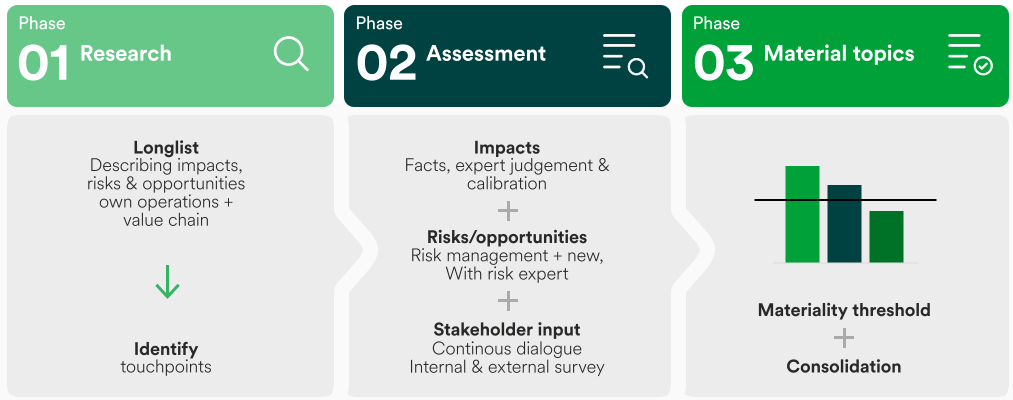
Starting with the compilation of a so-called longlist, Lenzing conducted a comprehensive examination of activities within its own business operations and value chain. The primary focus was on assessing IROs, considering impacts the company has on ESG topics and the impact the ESG topics have on the company (double materiality).
[IRO-1 53g]
The IRO assessment was informed by insights into sustainability issues, stakeholder needs and value chain research. Internal data collection involved drawing information from existing sources and internal expert knowledge. External data collection involved consulting scientific papers, reports from NGOs and reviewing industry reports.
[IRO-1 53e, 53f]
Lenzing’s risk management team provided expertise in assessing risks and opportunities. Most ESG risks and opportunities were already part of Lenzing’s risk management system and process, which is described in the “Risk management reporting” section in this chapter. The risks and opportunities that were additionally identified will be integrated successively into the risk management system. At present, impacts are not part of the risk management process.
Context analysis
[E2 IRO-1 11a, E3 IRO-1 8a, E5 IRO-1 11a]
For environmental impacts, including the topics of climate, pollution, water and resource use, a context analysis is performed annually at Lenzing’s production sites to screen assets and activities, with findings consolidated at global level.
The context analysis and the other parts of the environmental management system are integrated into the DMA process. At product level, LCA is the primary tool used for assessing cradle-to-gate impacts within direct and indirect operations, including the company’s own pulp and fiber production and upstream supply chains. This not only supports substantiation of product-related environmental claims but also enables identification of areas for improvement such as pulp production (including recycling) or key chemicals. The procedure is supported by the environmental data collection process relating to in-house operations, including energy consumption and GHG emissions, other air emissions, water use, effluents, discharges of priority substances of concern and waste. In addition, primary data collection from suppliers is steadily increasing (e.g. on water use): while the focus was initially on pulp suppliers, primary data are now also being requested from important chemical suppliers. This systematic collection of data from Lenzing’s own production and its suppliers is performed on demand and feeds into the continuous updates of LCA calculations for Lenzing’s products.
Pollution
In addition to the in-house environmental data collection process, the Higg Facility Environmental Module and the platform ZDHC Gateway help to evaluate performance. This is further supported by Lenzing’s chemical management system and the chemicals inventory.
Water
Water risk assessment at the corporate level is carried out by collecting contextualized qualitative and quantitative information on the supply chain and Lenzing’s own production using the WRI Aqueduct Water Risk Atlas and WWF Water Risk Filter. These data and tools not only support evaluation of the current water situation and identification of areas with water risk for specific locations, including regions of high water stress. They also provide insight into future scenarios, such as those reflecting the effects of climate change on water availability and quality. This activity is a continuous annual process and was again conducted in the reporting year.
Resource use and circular economy
Resource use and circular economy affect various areas – from measuring resource inflows and waste to the circularity of products. These areas are assessed and measured using the tools mentioned above.
Approach
[IRO-1 53b i, ii]
In general, Lenzing endeavors to use a conservative approach for its double materiality analysis. The company mapped its key business relationships within its value chain, ensuring that indirect impacts are appropriately captured. An example of environmental impacts that Lenzing is aware of and that result from its business relationships are impacts from its wood and pulp suppliers. In this case, the environmental impacts are well established.
When considering environmental impacts and environmental-related risks in its own operations, Lenzing focused on production sites, as these inherently pose a higher risk of adverse impacts compared to office locations. The assessment of social impacts on workers in the value chain is an area where Lenzing recognizes the need for further improvement.
[IRO-1 53c i]
Lenzing considered the interconnections between IROs and tracked their cause-and-effect relationships to ensure that no IRO is overlooked during the evaluation process.
Assessment
Impact assessment
[IRO-1 53b, 53b iv, 53d]
The evaluation of impacts’ severity was based on the following factors: scale, scope (for all impacts), irremediability (for negative impacts) and likelihood (for potential impacts). Impacts were then assigned following attributes:
positive/negative
actual/potential
direct/indirect
short-term (under one year)/medium-term (one to five years)/long-term (more than five years)
All factors (scale, scope, irremediability and likelihood) ranged from zero to five, with five considered the highest level (such as not recoverable or irreversible when measuring irremediability). Severity was assessed by the topic experts according to scale, scope, and irremediability. Scale depicts the magnitude of the impact regarding the respective ESG topic. Scope considered the geographic reach of environmental impacts or the number of people affected in the event of social impacts. Irremediability, which is only applicable to negative impacts, illustrates how difficult it is to reverse an impact. Likelihood describes the frequency of potential impacts, from once in ten years to several times per month.
For an impact to be considered material, three rules were applied: 1) If any of the values of scope, scale, irremediability or likelihood is a five, the assessed impact is further scrutinized to determine actual materiality. 2) If the severity (average of scale, scope, irremediability) lies above the materiality threshold of 3.7, the assessed impact is material. 3) For “potential” impacts, the likelihood was also taken into consideration in the form of a severity/likelihood matrix. For human rights topics an additional matrix was used, in which severity takes precedence over likelihood.
To validate the results (which continue to apply in 2025), the assessment in 2024 was reviewed on two workshop days, including experts from the Corporate Sustainability and other relevant departments. Every impact evaluation was explained by experts and reflected as well as discussed in the group to achieve mutual agreement and interpretation of the results.
Risk and opportunity assessment
[IRO-1 53c, 53c ii]
The following scales were used in relation to Lenzing’s ESG risks and opportunities and their financial impact at the sub-topic level: on a scale of one to four (with four being the highest, at over EUR 3 million) describing the magnitude of the financial impact of the risk/opportunity for Lenzing; on a scale of one to five, the likelihood of occurrence (with five representing the highest likelihood). The assigned time horizons are identical to those of the impact assessment. The nature of the impacts was attributed to the following categories: financial/manufacturing/natural/intellectual/human/social & relationship. A financial impact/likelihood matrix was defined to determine materiality.
The assessment was substantially supported by a Lenzing risk expert who helped to harmonize the approach based on knowledge, data and guidance. For more information on the climate-related risk assessment and the nature-related risk assessment, please see the corresponding sections below in this chapter.
[IRO-1 53c iii]
The above-mentioned approach for the risk and opportunity assessment was chosen to find a qualitative way to evaluate Lenzing’s heterogeneous ESG risks. Risks in Lenzing’s risk management system are usually assessed quantitatively applying the Monte Carlo method. In Lenzing’s risk management system, however, ESG risks are either assessed qualitatively or quantitatively using different methods depending on their nature, data availability and requirements from different standards and ratings, such as TCFD and CDP.
Stakeholder interests
[IRO-1 53b iii, E2 IRO-1 11b, E3 IRO-1 8b, E5 IRO-1 11b]
Throughout the year, Lenzing maintains a continuous dialog with its stakeholders. For information on Lenzing’s stakeholders, please see the “Stakeholder management” section in this chapter.
The frequency of involvement varies depending on the topic and production site. For example, consultation with affected communities about environmental topics, such as noise and odor, varies greatly from site to site, especially at Lenzing sites with high proximity to potentially affected communities such as Nanjing (China), Lenzing (Austria) and Purwakarta (Indonesia), which are consulted on a regular basis.
To gather further input, both internal (including the Managing Board and heads of various departments and relevant experts) and external stakeholders (suppliers, customers, NGOs, the Supervisory Board, investors and academia) participated in a survey. The continuous dialog and the results of the survey were used in the double materiality analysis for informing and prioritizing Lenzing’s material topics.
The process identified key stakeholder interests related to Lenzing, including expectations regarding ESG topic prioritization. These interests were subsequently evaluated to determine their significance for the material topics.
For further information on the updated materiality analysis, please see the “Double materiality analysis” focus paper.
Climate-related risk assessment
Lenzing applies the recommendations of the Task Force on Climate-related Financial Disclosures (TCFD) to identify, assess and manage climate-related impacts, risks, and opportunities. This process is embedded in the Enterprise Risk Management (ERM) system and reviewed annually to ensure alignment with evolving market and regulatory expectations. It includes consideration of the company’s greenhouse gas emissions across Scope 1, 2, and 3 and evaluates how these emissions influence Lenzing’s exposure to climate-related risks and opportunities.
[E1 IRO-1 20b, 20c]
The assessment uses a digital twin approach, which models Lenzing’s assets and business activities in a virtual environment including the value chain. This enables the simulation of climate-related hazards and transition events under different scenarios and provides directional insights into potential financial impacts on cash flows, including revenue and cost implications. Physical risks refer to the potential impacts of climate-related hazards such as heatwaves, droughts, flooding, and windstorms, which may lead to asset damage, operational disruptions, and supply chain interruptions. Transition risks refer to the potential impacts arising from the shift to a low-carbon economy, including regulatory changes, carbon pricing, technology developments, and changes in consumer preferences, which may affect production costs, market demand, and reputation. Opportunities identified include the development of low-carbon products and technologies that support the transition to climate change mitigation scenarios.
[E1 IRO-1 20b, 21]
Scenario analysis is the basis for the identification and assessment of these risks and opportunities over short- (five years), medium- (ten years), and long-term (twenty years) horizons. The company applies multiple climate pathways based on IPCC’s Shared Socioeconomic Pathways (SSPs)1, ranging from low-emission scenarios to high-emission scenarios. The two opposite extreme climate scenarios for high emission levels (SSP3-7.0, “Current Policies”) as well as the “Net Zero 2050” low-emission scenario (SSP1-2.6) were taken into special consideration for the assessment of physical and transition risks, respectively. The results of these two scenarios and a “Nationally Determined Contributions (NDCs)” scenario (SSP2-4.5) as well as their characteristics are described in detail in the tables “Risk and opportunity assessment – climate scenario characteristics” and “Projected Climate Risk Potential” in the “E1 Climate change” chapter.
Following last year’s assessment, few methodological changes were introduced in 2025. These updates replace previous outlooks with latest storylines from the Network for Greening the Financial System (NGFS) Phase V, offering a clearer and more current view of how the world may respond to climate challenges. Lenzing maintained its TCFD-aligned approach and continued to monitor developments in climate science and regulation. Minor database updates required for model refinements have been included during the reporting year, such as wildfire impacts for physical risks on assets and raw materials like eucalyptus, hence the recalculated simulation produced updated results with slight changes to previous year. The company acknowledges that climate risk quantification involves inherent uncertainty due to complex interdependencies and evolving external conditions. For this reason, in order to guide strategic decision-making and resilience planning, results are presented qualitatively.
Nature-related risk assessment
[E4 IRO-1]
[E4-1 13a, 13d]
In the reporting year, Lenzing continued its work under the Taskforce on Nature-related Financial Disclosures (TNFD) framework. This builds on the initial resilience analysis conducted in the previous year using the LEAP approach (Locate, Evaluate, Assess, Prepare)2. The company maintained its focus on evaluating nature-related physical, transition, and systemic risks as part of its Biodiversity Approach and Action Plan.
The assessment is based on three climate scenarios3: SSP1-1.9, SSP2-4.5, and SSP5-8.5. These scenarios provide insights into potential impacts under different emission pathways. They were applied to short-term (0–1 year), mid-term (1–5 years), and long-term (5–30 years) horizons.
[E4-1 13b, 13e]
The scope covers nine production sites in Austria, the Czech Republic, the United Kingdom, China, the USA, Thailand, Indonesia and Brazil. It also includes the wood supply chain in Austria and the Czech Republic. This supply accounts for about 70 to 80 percent of the wood used in Lenzing’s European pulp mills.
[E4-1 13c, 13f]
Key assumptions remain unchanged. The resilience analysis did not assume a collapse of planetary ecosystems in the short- and medium-term scenarios. Detailed ecosystem scenario modeling was not yet included due to limited data availability. Expansion of the analysis, including broader coverage of the wood supply chain, is planned for future reporting periods. Upcoming methods and frameworks for state-of-nature assessment and ecosystem scenario modelling are monitored and assessed for applicability to Lenzing’s context through the research collaboration with Wood K Plus (see in the “Actions” section in the "E4 Biodiversity and ecosystems” chapter). No stakeholders participated in the assessment, but Lenzing aims to increase their involvement in upcoming phases.
[E4-1 13e]
Dependencies
Wood is the most important raw material for Lenzing. Lenzing is also mainly dependent on healthy forest ecosystems, as biodiversity and ecological functioning underpin the availability of wood.
Lenzing addresses these dependencies by prioritizing wood from well-managed forests and plantations certified under internationally recognized standards such as FSC® and PEFC.4 These certifications include stringent biodiversity protection criteria and help maintain ecosystem services such as carbon sequestration, water regulation and habitat provision.
Lenzing uses two types of forestry in different global regions. In the Northern Hemisphere, wood and pulp suppliers in Europe and North America apply sustainable, multi-functional forest management. In the Southern Hemisphere, plantation forestry with high sustainability standards is practiced by Lenzing’s pulp supplier in South Africa and at its own pulp plant in Indianópolis (Brazil).
Plantation forestry helps reduce pressure on natural forests by providing high-yield wood as an alternative to sourcing from primary forests. Although plantations represent only three percent of global forest area, they supply around 33 percent of global timber.5
Risks
Risks identified in previous years remain relevant. Physical risks include droughts, floods, water stress, and forest health decline. Transition risks relate to regulatory changes and biodiversity requirements. Systemic risks arise from ecosystem disruptions and governance inconsistencies. These risks may cause operational disruptions, supply chain interruptions and resource price volatility over time, especially under high-emission scenarios.
Systemic risks and physical hazards such as floods and droughts require ongoing contingency planning. In the short term, these risks remain moderate but show early signs of stress. They become more pronounced over the medium-term. In the long-term, systemic and physical risks could escalate significantly, especially under high GHG emission scenarios. This highlights the need for adaptive strategies to ensure long-term sustainability and resilience.
For more information on mitigation of nature-related risks, please see the “Actions” section of the “E4 Biodiversity and ecosystems” chapter.
Impacts
The primary potential impact on biodiversity and ecosystems arises from forestry-related land use in the Lenzing Group’s operations and supply chain.
No significant impacts have been documented on biodiversity-sensitive or protected areas within 10 km of Lenzing’s production sites or up to 30 km downstream. Likewise, no effects on threatened species have been attributed to Lenzing’s operations. Therefore, it is not necessary to implement biodiversity mitigation measures in this regard. Further information on “Biodiversity sensitive areas and protected sites near Lenzing production sites” can be found in the section of the same name in the “annex”.
Potential impacts on water, soil, and air can arise from production facility emissions or from transportation. For more information, please see the chapters “E2 Pollution”, and “E3 Water and marine resources”.
At the end of the textile and nonwoven value chain, biodiversity impacts may occur if non-degradable materials enter the environment due to incorrect disposal. For more information on biodegradability of Lenzing’s fibers, please see the “Metrics” section in the “E5 Resource use and circular economy” chapter.
TNFD disclosures
For TNFD disclosures in metrics addressing wood scarcity and related to changes in land use, please see the table in the “Metrics” section of the “E4 Biodiversity and ecosystems” chapter. Additional metrics and indicators recommended by TNFD that are not directly connected to Lenzing’s ESRS IROs, can be found here.
Compliance-related assessment
[G1 ESRS 2 IRO-1]
In the process of identifying material impacts, risks and opportunities, materiality was evaluated based on metrics such as the number of reported cases, confirmed incidents as well as stakeholder interests. For example, the evaluation of the whistleblower protection topic and the prevention and detection of corruption was influenced heavily by Lenzing’s stakeholders, such as investors, reflecting their high interest in this topic.
1IPCC, Sixth Assessment Report, 2021.
2Guidance on the identification and assessment of nature-related issues: the LEAP approach – TNFD
3SSP1-1.9, SSP2-4.5 and SSP5-8.5. For a description see https://www.dkrz.de/en/communication/climate-simulations/cmip6-en/the-ssp-scenarios
4License codes: FSC-C041246, PEFC/06-33-92
5Bousfield et al., Nature Geoscience 16(2023), 1145-50 https://www.nature.com/articles/s41561-023-01323-y