Sourcing
[G1-2 15a, 15b]
List of key actions
Sustainable chemical sourcing
Sustainable wood and dissolving wood pulp sourcing
Wood, pulp and chemicals purchasing are handled by three different teams within the Lenzing Group. Lenzing aims to minimize purchasing risks, such as major price fluctuations and supply bottlenecks through reliable, long-term supply relationships and active supplier management. The most important materials procured are (in order of annual procurement volume): wood, dissolving wood pulp, sodium hydroxide, sulfuric acid, sulfur, carbon disulfide, sulfur dioxide and magnesium oxide.
In 2025 (and 2024), when screening for risk suppliers, no Lenzing suppliers were identified as having significant actual and potential negative environmental impacts. This statement is based on the following tools and certifications schemes: EcoVadis, Together for Sustainability, FSC® and PEFC.
Directives and polices are implemented throughout supplier engagements. Lenzing strives to lead as an industry role model for ethical business conduct, while expecting the same standards from its business partners. For more information about the Supplier Code of Conduct, please see the “Policies” section in this chapter.
[MDR-M 77 b]
The metrics in this section are not validated by an external body other than the assurance provider.
Sustainable chemical sourcing
Supplier engagement
[MDR-A 68a, 68b, 68c]
The current Supplier Engagement target aims to continuously engage with key chemical suppliers, therefore Lenzing has signed agreements, including sustainability clauses, with its key chemical suppliers. Some of these conditions include setting GHG reduction targets approved by the Science Based Target initiative (SBTi) to provide information on the product carbon footprint and water scarcity at facilities from which Lenzing sources products.
Supplier management through EcoVadis
[entity-specific]
2025 |
1,025 |
2024 |
824 |
|---|---|
2023 |
608 |
2022 |
387 |
2021 |
163 |
2020 |
152 |
2019 |
102 |
2018 |
93 |
2017 |
82 |
For the percent of total spend covered by audits, please see the “Targets” section in the “S2 Workers in the value chain” chapter.
Lenzing engages only with EcoVadis rated suppliers that achieve a minimum score of 50 points. For more information about EcoVadis and the average EcoVadis score of Lenzing’s suppliers please see the “Actions” and “Metrics” sections in the “S2 Workers in the value chain” chapter.
Regionality
[entity-specific]
In 2025, 80 percent of all purchased chemicals (in liquid metric tons) were delivered by 33 suppliers (2024: 36 suppliers). Relationships with these suppliers are in general highly stable.
Sustainable wood and dissolving wood pulp sourcing
[MDR-A 68a, 68b, 68c]
Wood and dissolving wood pulp are Lenzing’s most important raw materials. The Lenzing Group demonstrates responsibility by focusing on continuous sustainable sourcing. The sourcing is covered by certification, responsible consumption, and the highly efficient use of these valuable resources.
Lenzing sources wood and dissolving wood pulp from semi-natural forests as well as from plantations, both as defined by the Food and Agriculture Organization of the United Nations (FAO)1,2. Semi-natural forests include naturally regenerating and planted forests with similar species composition to that of natural forests in the area. Lenzing does not source wood and dissolving wood from primary, natural or ancient and endangered forests.
Assuming a dissolving wood pulp yield from wood of 40 percent, a rough estimate for the total yearly wood input of Lenzing’s regenerated cellulose fibers would amount to 2.5 million tons (dry matter). The wood input is split between Lenzing’s own production and purchased dissolving wood pulp.
Dissolving wood pulp sources
In addition to its own dissolving wood pulp production, Lenzing procures dissolving wood pulp from the global market, mostly under long-term supply contracts. Please find the list of Lenzing’s pulp suppliers on Lenzing’s website.
Wood sources
Lenzing operates three pulp mills where wood is turned into dissolving wood pulp. Regional wood supply is important to Lenzing, since this represents one measure to reduce GHG emissions deriving from transportation.
Regional wood supply in Europe
[entity-specific]
Lenzing is committed to source the wood for its pulp mills in Europe as locally as possible. The Lenzing site (Austria) mainly uses beech wood plus small amounts of other hardwoods and spruce, whereas the Paskov plant (Czech Republic) mainly uses spruce.
Wood sourcing for Lenzing’s pulp mills in Europe
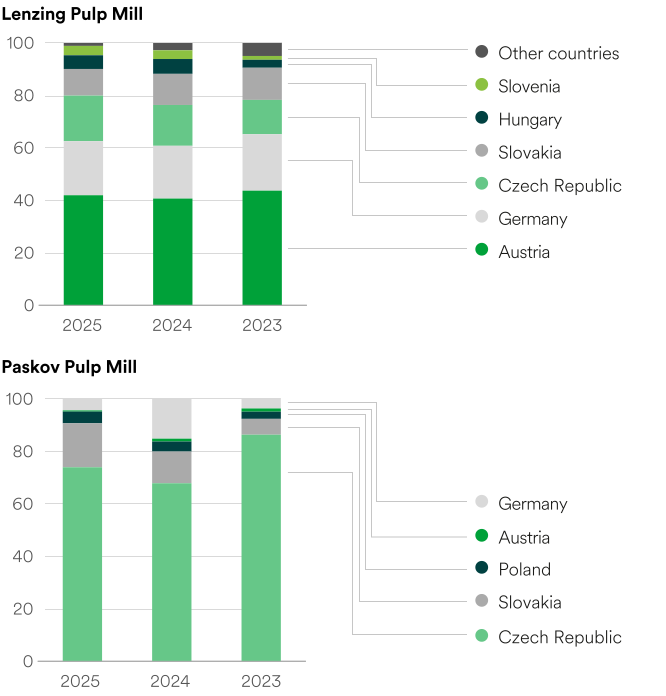
For the Lenzing site (Austria) regional wood3 accounted for 98.8 percent in 2025 (2024: 97.1 percent). For the Paskov site (Czech Republic), the regional supply rate has been constant at 100 percent since 2019. For the underlying figures, please see the “Annex”.
Local wood supply in Brazil
Lenzing’s pulp mill in Indianópolis (Brazil), a joint venture with Dexco under the name of LD Celulose, uses eucalyptus from its own plantations. These plantations operate entirely in compliance with the Lenzing Group’s guidelines and high standards for the sourcing of wood and pulp as well as with the requirements of leading certification schemes.
The plantations are located in Triângulo Mineiro in the State of Minas Gerais. The area that was transformed into the LD Celulose plantation unit has been used for cattle raising, intensive agricultural activities and eucalyptus forestry since the 1970s. The plantations are located more than 800 kilometers away from the Amazon rainforest region.
For more information about Lenzing’s plantations in Brazil, please see the “Actions” section of the “E4 Biodiversity and ecosystems” chapter.
Due diligence wood and pulp
Lenzing’s wood and pulp sourcing due diligence consists of the following steps:
Policies – Wood and Pulp Policy and Supplier Code of Conduct
Supplier evaluation
Certifications and independent assessments – FSC®, PEFC and Canopy
Wood and Pulp Policy and Supplier Code of Conduct
The Lenzing Wood and Pulp Policy and Supplier Code of Conduct apply to all wood purchasing activities and are provided to potential suppliers before a business relationship begins. Deliveries to Lenzing are only permitted if these conditions are accepted. For information on the Supplier Code of Conduct, please see the “Policies” section of this chapter. For the Wood and Pulp Policy, please see the “Policies” section of the “E4 Biodiversity and ecosystems” chapter.
Supplier evaluation
[MDR-A 68a, 68b, 68c]
All key suppliers of wood and dissolving pulp are evaluated for sustainability performance. Lenzing’s key suppliers are mostly those of significant size and supply volume.
Lenzing conducts regular audits and sustainability assessments of both new and established suppliers, including compliance with environmental and safety standards. Suppliers are periodically interviewed and evaluated with support from external experts, followed by a final assessment. These results feed into the overall supplier rating and serve as a key criterion for long-term supplier cooperation.
Pulp suppliers are assessed using a due diligence system based on FSC® Controlled Wood criteria. This includes an annual assessment of pulp suppliers’ sustainability performance, using a comprehensive questionnaire covering aspects such as procurement standards, supply areas, supply chain traceability and GHG emissions. The results of the survey are used to identify key sustainability issues and guide Lenzing’s future supplier engagement activities. All pulp suppliers are certified by leading forest certification schemes and supply Lenzing with certified or controlled pulp.
All wood suppliers – totaling to around 700 (in 2024: more than 600) half of which are private owners – in all sourcing countries are assessed once a year against FSC® Controlled Wood and PEFC Controlled Sources criteria.
Certifications – FSC®, PEFC and Canopy
[entity-specific]
Lenzing ranked #1 by Canopy
#1 Globally: Lenzing leads Canopy Hot Button Ranking and was awarded the “Dark Green Shirt”. The Hot Button Ranking is a leading industry assessment of global pulp and fiber producers’ sustainability performance, including topics such as forest conservation, supply chain transparency, and innovation. Canopy credited Lenzing an impressive 34.5 out of 40 points, with leading scores in the areas of sourcing, conservation, and next-generation solutions.
Certification status
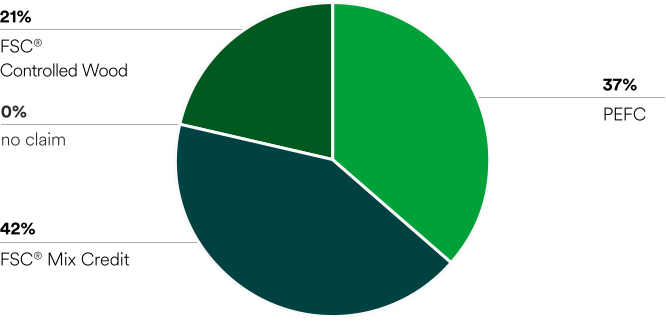
Basis: dissolving wood pulp by weight.
[MDR-A 68a, 68b, 68c]
100 percent of wood and dissolving wood pulp used by the Lenzing Group is continuously either certified by FSC® and PEFC or controlled and inspected in line with these standards.4 Wood with a PEFC certificate also receives the status FSC® Controlled Wood. For the certification status, please see the “Certification status” figure. “Certified” represents the sum of “FSC® Mix Credit” and “PEFC”. This reflects the amount of pulp available to make fibers with the corresponding Chain of Custody certification.
Lenzing’s Chain of Custody (CoC) certifications also enable its customers to have their products certified. The Chain of Custody documents the flow of materials from the forest source through all supply chain stages up to the final product. All Lenzing Group production sites are FSC® CoC certified. The multi-site certification for PEFC CoC currently covers five sites: Lenzing (Austria), Paskov (Czech Republic), Purwakarta (Indonesia), Nanjing (China) and Mobile (USA).
PEFC certification is mainly used for wood sourced from Central Europe. FSC® certification of forests is not widespread in this region. Therefore, most of the wood sourced in Europe is procured with a PEFC certificate and receives FSC® Controlled Wood status at Lenzing sites after a due diligence process. As a result, all wood input to the Lenzing Group is either certified or controlled by the FSC® certification system as well. As forestry operations in Central Europe are generally small in scale, many small forest owners harvest wood for additional income and do not participate in a certification process. Therefore, Lenzing occasionally procures reliable but limited quantities of such wood that is not FSC® or PEFC certified. This category of wood is inspected in line with these standards and counts as controlled wood. Stringent forestry legislation and enforcement in Central Europe also requires all forest owners to pursue sustainable management.
Pulp suppliers can hold more than one forest-related certificate. Most of the pulp suppliers located in North America also carry certification from the Sustainable Forest Initiative (SFI), which is also a national member of, and fully endorsed by, the global PEFC certification scheme.
For detailed explanations of the certificates, controlled wood and the internal due diligence system, please see the “Wood and pulp” focus paper.
1Carle, J., and Holmgren, P. (2003). Working paper 79. Definitions Related to Planted Forests. In: Food and Agriculture Organization of the United Nations (2003). Forest Resources Assessment Program Working paper series. Available at: https://openknowledge.fao.org/server/api/core/bitstreams/56870b47-e648-4d9e-855a-560e45b63992/content
2Terms and Definitions, FRA 2020, FAO, 2018 https://openknowledge.fao.org/server/api/core/bitstreams/531a9e1b-596d-4b07-b9fd-3103fb4d0e72/content
3Regional wood supply originates from the country where the pulp mill is situated and from neighboring countries from which wood can be transported directly without crossing a third country.
4License codes: FSC-C041246, PEFC/06-33-92