
Actions
[E5-2, MDR-A 68a]
List of key actions
Biorefinery for pulp production
Commercial-scale recycling technologies
Collaboration and research
Biorefinery for pulp production
[E5-2 20a, MDR-A 68a, 68b, 68c]
During pulp production, wood is converted into dissolving wood pulp for use in subsequent fiber production. At Lenzing’s pulp sites, this process is energy self-sufficient, uses raw materials efficiently and achieves high recovery rates for solvents and chemicals. As a result, marketable biorefinery products and energy are generated while production waste is minimized (see the figure ”Highly efficient use of the raw material wood”). The Lenzing Group currently operates three biorefineries in Lenzing (Austria), Paskov (Czech Republic) and Indianópolis (Brazil). These supply valuable biorefinery products to various industries and contribute to the efficient use of wood and process chemicals in a circular system. Each site produces a specific portfolio of biorefinery products.
Highly efficient use of the raw material wood
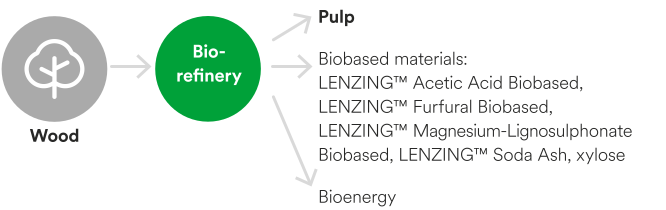
Surplus energy from pulp production is supplied as renewable energy in the form of steam and electricity. At the Lenzing (Austria) site, this surplus energy is used directly to power fiber production lines. In Paskov (Czech Republic) and Indianópolis (Brazil), surplus energy is exported to the electricity grid, thereby contributing to the regional transition toward renewable energy. This illustrates the cascading use of biomass and the 100 percent utilization of the raw material wood.
Commercial-scale recycling technologies
[E5-2 20b, MDR-A 68a, 68b, 68c]
Recycling requires a holistic approach. Textile recycling processes can be energy-intensive due to the complex disassembly of garments, material blends and chemicals applied in textile production. To truly mitigate climate change and other potential environmental impacts the following factors have to be taken into consideration: e.g. design for circularity, the use of renewable energy and “low-impact” chemicals in the value chain. Brands and retailers play an important role by not only offering products with recycled content to consumers but also by designing apparel to facilitate circularity in terms of durability, recyclability and biodegradability.
Lenzing deploys two types of recycling within its product portfolio: chemical and mechanical, both of which are ongoing activities.
Chemical recycling
To address textile industry waste challenges, Lenzing has developed the innovative REFIBRA™ recycling technology. This process converts pre- and post-consumer cellulosic textile waste from cotton or regenerated cellulose, together with virgin pulp, into new fibers. Lenzing’s R&D teams are continuously working to further enhance this technology.
LENZING™ ECOVERO™ branded viscose fibers produced with REFIBRA™ technology contain a minimum of 20 percent recycled content from pre- and post-consumer textile waste. These fibers deliver high quality and performance equivalent to fibers made from virgin dissolving wood pulp. The fiber is certified under the Recycled Claim Standard (RCS), confirming that all production steps throughout the entire supply chain meet the requirements to ensure the integrity of the final product.
Mechanical recycling
Lenzing fibers can be used as blending partners to enhance mechanically recycled textile materials from post-industrial and pre-/post-consumer sources. During mechanical recycling, textiles are shredded down to individual fiber level as far as possible. Due to the shortening of fiber length and loss of performance such as tenacity, these mechanically recycled fiber materials require carrier fibers in order to be “respun” into new high quality yarns. Lenzing fibers are successfully used as carrier material for mechanically recycled fibers.
Collaboration and research
[MDR-A 68a, 68b, 68c]
In 2025, Lenzing Group has numerous ongoing long-term research collaborations aimed at advancing textile recycling technologies and at strengthening the understanding of circularity among policymakers and industry stakeholders. The overarching goal is to accelerate the transition toward a circular economy in the textile and nonwovens sector. Lenzing collaborates with partners such as Södra, CELLFIL and TreeToTextile in several research projects, which are described below. The total R&D expenditure at Group-level in 2025 (calculated according to the Frascati method) amounted to EUR 31.7 million (2024: EUR 30.4 million). The R&D expenditure is entity-specific information.
Södra
To accelerate technological development in textile recycling and expand capacity for generating pulp from post-consumer textile waste, Lenzing began collaborating with Södra, a leading global pulp producer, in 2021. The joint goal is to recycle and process 50,000 tons of textile waste per year at Södra’s Mörrum site by 2029. This initiative, known as “Textile Recycling in Europe AT Scale” (LIFE TREATS), is supported by an EU subsidy of EUR 10 mn as part of the LIFE 2022 program (project ID 101113614), which aims to further develop the innovative OnceMore® recycling process.
CELLulose lyocell FILaments (CELLFIL)
Lenzing is a participant and the technical coordinator in CELLFIL – CELLulose lyocell FILaments (project ID 101135042), which was launched in 2024 as a scalable solution for circular textile production. This project focuses on lyocell filament TENCEL™ Luxe, which has been developed by Lenzing over the course of the last decade. CELLFIL now spans the entire value chain, ranging from raw materials and various production steps through to end-use applications. As part of the project, nine prototype products are being developed across three categories: performance wear, automotive textiles as well as technical textiles and reinforcements. This process involves designing, developing and validating end-use textile applications that use optimized lyocell filament yarns and fabrics that offer enhanced recyclability. By spanning the entire value chain, this project seeks to demonstrate the potential for cellulose filaments to replace fossil-based counterparts that dominate today’s textile industry. As a consequence, CELLFIL ultimately aims to transform the European textile value chain by developing sustainable, biobased lyocell filaments. Lenzing’s role as producer of TENCEL™ Luxe includes supplying suitable filament types to its partners as well as developing new variants, such as filaments containing cellulose from alternative sources. Development takes place in close cooperation with partners whose downstream trial results directly inform subsequent iterations of filament variants. Furthermore, Lenzing is working on additional process improvements to scale filament production to industrial levels. The project will drive innovation across the value chain by defining business models and strategies for market adoption by 2030, ultimately contributing to the development of a circular textile economy in Europe.
TreeToTextile
Lenzing acquired a non-controlling interest in the Swedish cellulose fiber company TreeToTextile AB in 2024, thereby forming a strategic partnership to develop next-generation cellulose fibers. TreeToTextile’s award-winning technology and production process, which significantly reduces environmental impacts, aligns with Lenzing’s commitment to sustainability. In February 2026, Lenzing acquired a controlling majority and became majority owner of TreeToTextile AB. With the majority acquisition, Lenzing underscores its commitment to consistently advancing its premiumization strategy. The transaction enables an accelerated scaling of the new technology. Lenzing plans a significant increase in production output at the existing demonstration plant in Nymölla, Sweden, as well as the preparation of the first industrial‑scale facility.
Policy discussions
In view of the technological challenges and regulatory obstacles associated with textile recycling in the EU, Lenzing contributes its knowledge and expertise to the following EU collaborations: Policy Hub, Textile Dialog, European Recycling Industries’ Confederation (EuRIC), Forum for the Future (international) and the Austrian Bioeconomy Strategy (Austria). Especially noteworthy are the two following collaborations with CISUTAC and ESCIB.
Circular and Sustainable Textile Clothing (CISUTAC)
Since October 2022, Lenzing has been a partner in the CISUTAC project, which is co-funded by the EU (project ID 101060375). This consortium was established to support the transition toward a circular and sustainable textile sector. Besides Lenzing, the 24 partners in the consortium include industry representatives such as Södra and Decathlon, NGOs such as Oxfam and academic institutions such as RISE and CENTEXBEL. The initiative aims to identify, prevent and eliminate barriers to circularity across the clothing value chain. Within this framework, Lenzing focuses on developing recycling processes for cellulose fibers in line with its corporate strategy, including the supply of fibers that enhance the quality of mechanically recycled cotton yarn.
Environmental Sustainability & Circularity Assessment Methodologies for Industrial Biobased Systems (ESCIB)
Lenzing is a participant in the EU-funded project ESCIB (project ID 101135071) – Environmental Sustainability & Circularity Assessment Methodologies for Industrial Biobased Systems – which was launched in early 2024. This project aims to develop crucial assessment methodologies that will help the European biobased economy to perform faster and more accurate assessments of their value chains. A core objective of ESCIB is to create standardized methodologies for life cycle and sustainability assessments of biobased systems at various technology-readiness levels (TRLs). This will help to further improve the sustainability of biobased products, reduce potential negative impacts and highlight the benefits of biobased products in comparison to fossil-based products. Lenzing is one of the industrial partners in the project, providing use cases and playing a central role in testing and validating the developed methods. Lenzing’s primary use case in the project is Lyocell™ filament, creating a strong link also to the EU-funded project CELLFIL.