Sustainability strategy
Our Vision
Our passion is to provide truly sustainable solutions for a growing world. We create a positive impact for the people we work with, the consumers we serve, and the society and environment in which we operate. In doing so, we are commercially successful.
Our Mission
We are change agents and collaborate with our suppliers and value chain partners to catalyze change for the better. We actively contribute towards improving environmental performance throughout the value chain and, as a consequence, in final products. We promote social wellbeing. The creation of more positive impacts and benefits is the central focus for our innovation and business practices.
Our Strategy
“Naturally Positive”
[SBM-1 40g]
Lenzing has defined a sustainability vision and mission that guide decision-making at all levels – from daily operational choices to long-term strategic planning. “Naturally Positive”, the Group’s sustainability strategy, is firmly rooted in Lenzing’s corporate strategy. Within the four strategic drivers of the corporate strategy – sustainability, innovation, premiumization and excellence – the sustainability strategy identifies the areas where Lenzing can exert the greatest positive impact. This approach enables Lenzing to adequately contribute to the United Nations’ Sustainable Development Goals (SDGs) most affected by its activities and to help address global and environmental challenges.
Lenzing primarily focuses on value creation by monetizing sustainability through specialty fibers that deliver a smaller environmental footprint, enhanced transparency and reduced supply-chain risks. These products also support customers in meeting regulatory requirements and achieving their own sustainability goals.
Strategic focus areas of sustainability and the corresponding SDGs
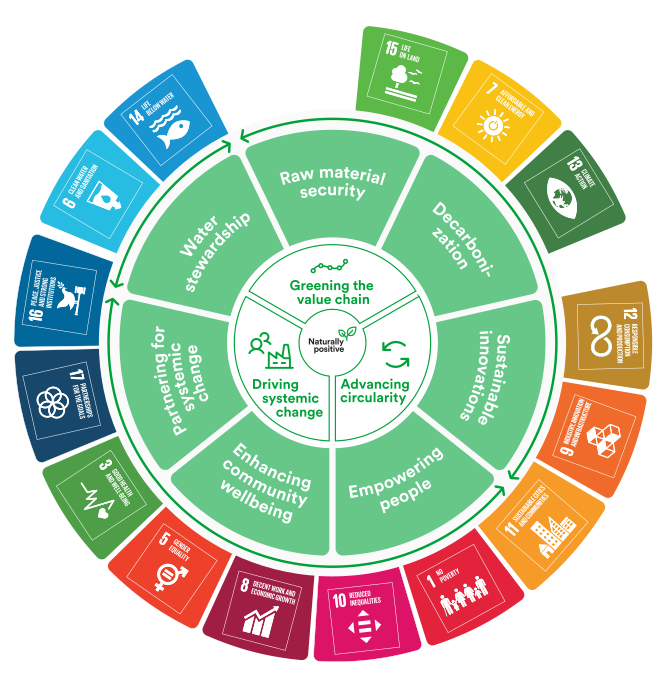
Lenzing’s sustainability strategy “Naturally Positive”, builds on three strategic principles. Within these principles, seven strategic focus areas were identified in which the Lenzing Group substantially contributes to creating positive impacts and benefits.
1. Driving systemic change
Complex global challenges require collaboration and systemic solutions shaped by multiple stakeholder groups. Transparency and traceability are prerequisites for fostering trust and long-term relationships. Through active contribution to industry-wide methods, standards and benchmarking tools, Lenzing helps to accelerate sustainability performance across the industry. Platforms such as ZDHC (Zero Discharge of Hazardous Chemicals), the FSLM (Facility Social Labor Module), concrete sustainability targets, supplier engagement programs and physical and digital traceability tools are key enablers in raising industry standards and overcoming shared challenges.
2. Advancing circularity
Lenzing aims to maximize value creation with minimum virgin resource use while reducing fossil-based inputs both in its own operations and along the wider value chain. The company unites the cellulose fiber cycle of its wood-based products (biological cycle) with its innovative technologies that focus on closing loops in the production and recovery of raw materials and chemicals (technical cycle). Dedicated targets for recycled-content fibers, circular business models with partners and the development of alternative cellulose feedstocks support this principle. For more information, please see the “E5 Resource use and circular economy” chapter.
3. Greening the value chain
Lenzing’s responsible practices and innovative products enable its customers and value chain partners to improve their environmental and social performance and meet their regulatory and sustainability commitments. Responsible sourcing, water stewardship, decarbonization, and sustainable innovations shape Lenzing’s contribution to a greener value chain. The sustainability targets for air emissions, water emissions, pollution, chemical management (ZDHC) and climate protection form the core of Lenzing’s responsible operations and act as drivers of technological progress.
Challenges
The main challenge ahead relates to the execution of Lenzing’s climate action plan. Progress is constrained by several external factors, including limited availability and accessibility of grid-based renewable electricity, high cost differentials between renewable fuels (green hydrogen, ammonia) and fossil-based electricity and fuels, the lack of a level playing field for low-carbon products, and an unwillingness on the part of business partners to share the costs and risks of investments on an equitable basis. In addition, international tariff measures and the resultant uncertainty have negatively impacted the global textile value chain and, subsequently, Lenzing’s business performance.
For further information on Lenzing’s sustainability strategy, strategic principles, and strategic focus areas, please see the “Sustainability strategy” focus paper.
Sustainability Policy
[MDR-P 65]
Policy |
Sustainability Policy |
|---|---|
Accountability |
Head of Corporate Sustainability |
Scope and coverage |
Lenzing Group |
Value chain |
|
Local communities |
|
Objective and key elements |
Objective: |
Key elements: |
|
Third party standards/initiatives |
Paris Climate Agreement (COP 21) |
Accessibility |
|
Topical standards |
E1 Climate Change E1-2 |
E5 Resource use and circular economy E5-1 |