Strategy
[ESRS E1-1]
Climate action plan
[E1-1 16a, 16g]
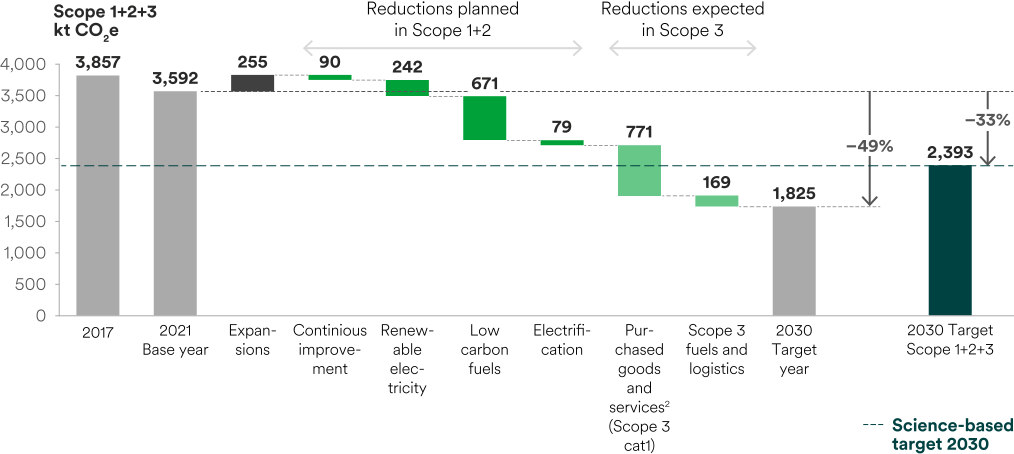
In line with the Paris Agreement’s 1.5 °C target and UN SDG 13, Lenzing has set ambitious near- and long-term science-based targets (SBTs). By 2030, the company plans to reduce absolute GHG emissions by 42 percent in Scope 1 and 2 and by 25 percent in Scope 3 (baseline 2021). Lenzing has a climate action plan until 2030, which is presented in the following box. In addition, Lenzing also aims to achieve net-zero GHG emissions by 2050. The Lenzing Group is included in the EU Paris-aligned benchmarks.
Climate Action Plan
[E1-1 14]
Lenzing is committed to its SBTs and has been implementing a corresponding roadmap until 2030. This roadmap is periodically updated to incorporate evolving technological options and changing market conditions.
Climate Action Plan1
Alignment with business strategy
[E1-1 16h, 16i, 17]
Lenzing’s corporate strategy incorporates climate targets into its strategic decision-making. The climate action plan for mitigation, approved by the Managing Board, is part of Lenzing’s long-term business strategy. Projects are assessed for their benefits and their contribution to climate change impact as part of the Managing Board’s decision-making process. In the yearly mid-term plan (MTP) budgeting process, projects are assessed for their relevance to the climate action plan and their GHG emissions. The results serve as an additional decision criteria. Lenzing is working to strengthen the plan to meet the formal requirements for a transition plan as defined under the European Sustainability Reporting Standards (ESRS) by 2028.
[E1-1 16b, 16c, MDR-A 69b]
Lenzing has invested around EUR 30 mn in its viscose site in Nanjing (China) to transition from coal to natural gas. In addition, Lenzing has implemented numerous climate-related initiatives. These include buying grid-based renewable energy at seven facilities globally and purchasing more than 70 percent biomass energy for its lyocell site in Prachinburi (Thailand). These initiatives have led to higher operational expenditures (OpEx) for the Group. Lenzing is able to offer premium products with a low-carbon footprint thanks to these measures. Additionally, Lenzing is constantly engaging with suppliers to procure low-carbon raw materials through long-term contracts. In accordance with its set SBTs ambitions and the climate action plan, innovative concepts to further decarbonize Lenzing sites and the supply chain in different countries are evaluated continuously (please see the roadmap for key levers). For example, Lenzing is considering an investment at its Heiligenkreuz (Austria) site in a project that would significantly reduce fossil fuel use and GHG emissions. For more information on the key actions described by the decarbonization levers, see the “Actions” section in this chapter.
Status and barriers
[E1-1 16 j]
At present, a challenging market environment, among other factors, hampers the implementation of key elements of the action plan. These include the availability and accessibility of grid-based renewable electricity and unequal costs of renewable fuels (such as green hydrogen and ammonia) compared to fossil-based energy sources. Further barriers include the lack of a level playing field for low-carbon products and the limited willingness of business partners to share the costs and risks of investments.
Lenzing collaborates with partners and policy makers to explore solutions that overcome these barriers, create incentives for implementing climate action plans, and support the transformation of the industry.
The existing cross-functional project team remains in place and is dedicated to deploying Lenzing’s decarbonization strategy under the leadership of the global project manager and with the sponsorship of the Chief Pulp & Technology Officer (CPO). The project management team includes a steering committee that aligns across all decision-makers and functions, expedites decisions and ensures the involvement of different owners of capital projects, sites and functions. The global project manager is operationally responsible for facilitating roadmap preparation and bringing best practice examples to implement climate targets at facility and group levels. This manager also supports functions in integrating climate considerations in business decisions. To ensure engagement and empowerment, production sites and functions are responsible for developing and implementing roadmaps to manage their portfolios and specific agendas in the medium- and long-term, facilitated by the global project manager.
Locked-in GHG emissions
[E1-1 16d]
Lenzing’s coal boilers at the site in Purwakarta (Indonesia) and the waste incineration plant at the site in Lenzing (Austria) are significant sources of future locked-in GHG emissions throughout their operational lifetimes. These emissions could jeopardize the achievement of near-term and net-zero SBTs if the current infrastructure is not changed. Replacing coal boilers with new equipment compatible with alternative fuels could substantially mitigate these risks and support the GHG emission reduction targets. However, many barriers and challenges remain and need to be addressed with the support of business partners and initiatives (see “Status and barriers” section).
Levers to reach science-based targets
[E1-1 16b]
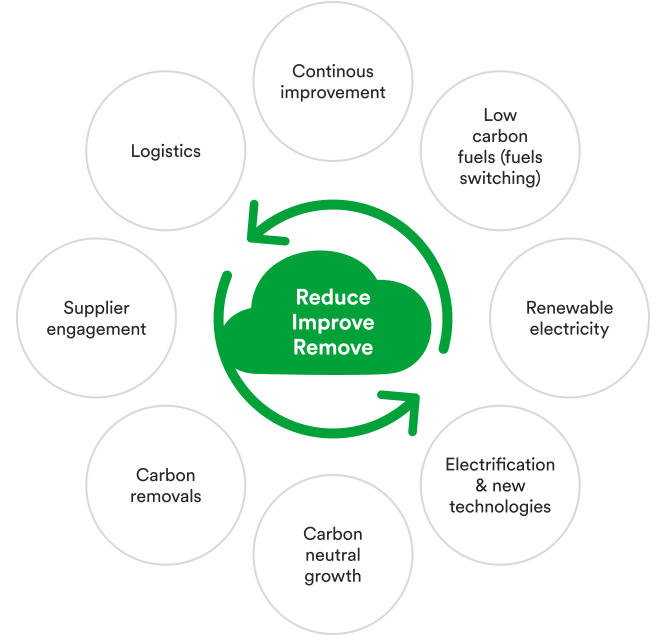
Based on technical feasibility, Lenzing deploys different levers to reduce Scope 1, 2 and 3 emissions, as shown in figure “Levers to reach science-based targets”. For additional information on the key actions described by the decarbonization levers, see the “Actions” section in this chapter.
Levers to reach science-based targets