
General Market Environment
Global economy1
The International Monetary Fund (IMF) reports stable global economic growth of 3.3 percent for 2025, which still lies well below the pre-crisis average (average for the years 2000–2019: 3.7 percent). The IMF shows a picture of a robust but subdued recovery, supported on the one hand by investments – such as in digital infrastructure and artificial intelligence – and somewhat looser monetary policy, but on the other hand weighed down by multiple geopolitical crises, disruptions to global trade and limited fiscal scope for maneuver. Pronounced disparities between the world’s regions persisted in 2025: in the USA, strong technology investment drove solid growth of 2.1 percent, while the Eurozone, held back by structural weaknesses and subdued industrial production, recorded moderate growth of 1.4 percent in 2025. China achieved growth of 5 percent in 2025, supported by stimulus measures and increased lending by state-owned banks. Overall, the global economy showed remarkable resilience despite uncertainty and trade policy tensions. Energy prices eased slightly, while structural challenges persisted in several regions. Political and geopolitical risks catered for uncertainty and weighed on confidence. For 2026, the IMF expects an unchanged growth rate of 3.3 percent.
The textile and apparel industry experienced weak demand and declining new order intake in 2025. The global business situation remained negative in all surveys conducted by the International Textile Manufacturers Federation (ITMF2) and deteriorated over the course of the year. Capacity utilization remained at low levels, reflecting the ongoing lack of demand. While manufacturers, particularly in the USA, accumulated stocks in the first half of the year in order to preempt potential tariffs, they responded with more cautious ordering in the second half of the year.
Global fiber market3
Global apparel sales grew only slightly in 2025 when adjusted for price effects, and remained subdued overall. In the USA, advance purchases in anticipation of tariffs provided a tangible short-term boost to demand. Europe exhibited significantly weaker performance, with somewhat subdued sentiment in the fashion retail sector. China remained stable despite low consumer sentiment, and benefited selectively from government measures.
In the first half of the year, stocks rose significantly along the entire value chain. Retailers and brands, particularly in the USA, accumulated stocks through earlier deliveries and faster transportation in anticipation of higher tariffs. In the third quarter, stock levels remained elevated due to more cautious demand and strategic stockpiling. Overall, global stocks were clearly above their pre-crisis levels, reflecting continued uncertainty in the market. Growth in the home textiles market continued to lag behind the apparel market in 2025. The impact on Lenzing’s textile fiber business is described in more detail in the chapter on business development by division under textile fibers.
Despite economic uncertainty, retail sales of hygiene products in the nonwovens industry grew, driven by demographic trends. This increase was mainly attributable to population growth in Asia and was accordingly weaker in Europe and the USA.
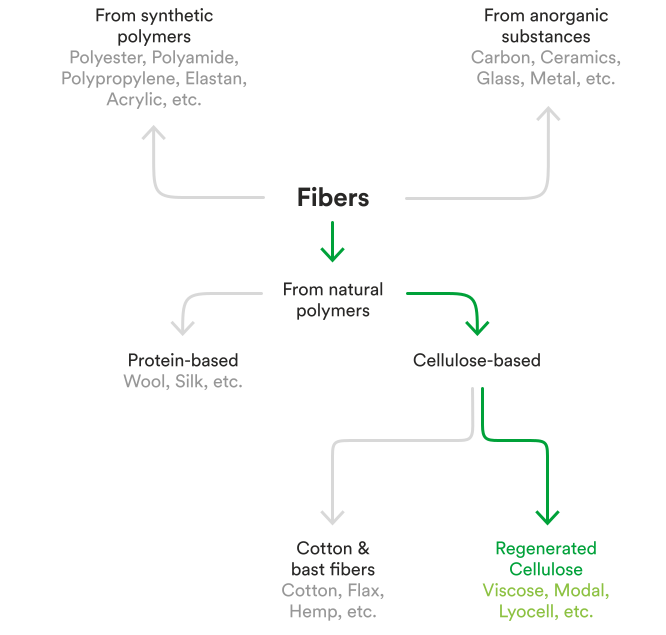
Fibers on the world market
(Simplified depiction)
Stable growth in global fiber production
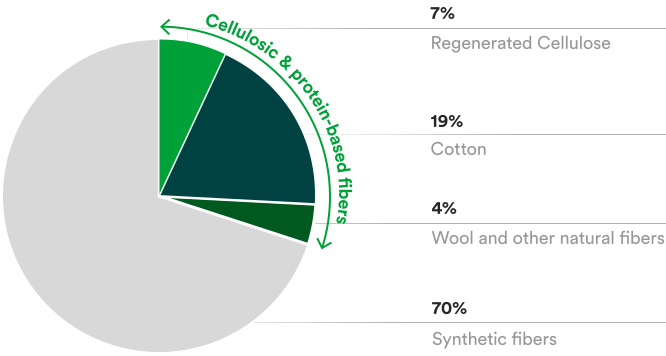
Global fiber production rose by slightly more than 4 percent to reach a level of 133 mn tons in 2025, according to initial estimates. Growth was consequently slightly above the long-term average and was primarily attributable to higher production of polyester and lyocell fibers in China, as well as a particularly strong cotton harvest in the 2024/2025 season.
The global cotton harvest reached an exceptionally high level of 25.8 mn tons in the past 2024/25 season due to record yields in China and a further expansion of acreage in Brazil. Global demand also rose slightly to 25.1 mn tons, but fell slightly short of supply due to economic uncertainties and pressure from cheaper synthetic alternatives. International cotton trade was slowed by the trade conflict between the USA and China. Overall, hardly any change occurred in global stocks, which amounted to around 15.9 mn tons at the end of the season. The production of other natural fibers such as wool, linen, hemp and silk also decreased by 5 percent year-on-year.
Production of regenerated cellulose fibers such as lyocell, modal and viscose increased by around 4 percent to approximately 8.7 mn tons, according to initial estimates. While global production of viscose fibers largely stagnated, the output of lyocell and modal fibers rose by a double-digit percentage rate.
For fibers made from synthetic polymers, production volumes amounted to around 92.7 mn tons according to initial estimates, representing an increase of 4 percent year on year. This growth is mainly due to higher output in China.
Global fiber production 20251
by type of fiber in percent (basis = 133 mn tons)
Staple fiber prices mixed
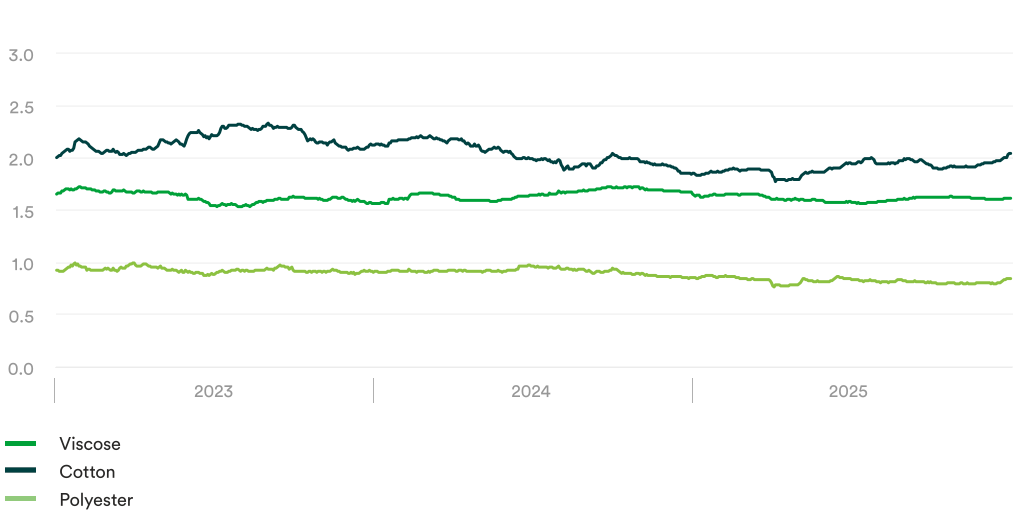
Prices for staple fibers were under pressure due to weak demand. Global economic uncertainties and the consequences of weaker but still noticeable inflation had a negative impact on disposable income. This reinforced the trend towards low-priced synthetic fibers.
Cotton prices were less volatile than in the previous year, but remained at a low level. This was partly due to the generally low demand for textiles, but also to an abundant harvest in China. Furthermore, the availability of cheap cotton from Brazil increased. The Cotlook A index stood at 79 US cents per pound at the start of the year, rose to 81 US cents per pound in the second quarter in anticipation of a potential trade agreement, which would also have included substantial Chinese cotton imports from the USA, but then fell again when the trade agreement failed to materialize. At the end of the year, the Cotlook A index stood at 74 US cents per pound, representing a decrease of 6 percent in 2025.
The price of polyester staple fibers was mainly determined by the trend in raw material costs. Accordingly, macroeconomic events suggesting a shortage in crude oil supply led to short-term price spikes. However, as Chinese producers in particular were producing polyester staple fibers at high capacity utilization rates, which led to ample supply, prices decreased by 6 percent over the course of the year from RMB 7,030 per ton to RMB 6,610 per ton. High supply of and low prices for Chinese polyester staple fibers also led to a rise in exports, which increased the pressure on other fiber types.
Following the uptrend in the previous year, viscose prices in China followed a downtrend in 2025. Despite a brief seasonal recovery in February and September, they ended the year 7 percent below their level at the start of the year at RMB 12,720 per ton. This development primarily reflects falling dissolving wood pulp prices. Despite the reduced prices, the economic situation of manufacturers without backward integration improved in China, as production costs there declined even more sharply than market prices.
The price premium for Lenzing’s differentiated specialty fibers from the TENCEL™, LENZING™ ECOVERO™ and VEOCEL™ brands, compared to commodity fibers, proved to be comparatively resilient. Altough prices for Lenzing fibers also declined over the course of the year.
The Chinese import price for dissolving wood pulp, the key raw material for the production of regenerated cellulose fibers, came under pressure in the first half of the year before stabilizing. At USD 785 per ton at the end of December, it was 19 percent lower than at the start of the year. Rising supply, primarily due to capacity expansions in South America, and the premium in relation to paper pulp, which made a switch from paper pulp to dissolving wood pulp attractive, led to price concessions by pulp producers. The price premium for dissolving wood pulp decreased to around USD 223 per ton at the end of the year.
Staple fiber prices – Development in China1
1Source: IMF, World Economic Outlook, January 2026
2Source: ITMF, Global Textile Industry Surveys 2025
3All production figures in this chapter have been updated compared with the initial estimates presented in the 2024 Annual Report. Sources: The Fiber Year, ICAC, Cotton Outlook, CCFG, FAO