Research and Development
Continuous innovation forms a key value driver of the Lenzing Group’s business model. The development of new products, applications, processes and technologies is purposefully driven to market readiness in order to create added value for customers, increase efficiency and improve sustainability performance. Innovation is regarded as a core element of the corporate strategy and is actively promoted across many areas of the company. The Global Innovation department, which also houses the R&D infrastructure (laboratories and pilot plants), is primarily responsible for technological developments as well as for the textile and nonwovens innovation groups. Working in close coordination, various cross-functional groups across the company collaborate with the technology groups, the sustainability department and the production units in order to further strengthen Lenzing’s innovative capabilities and enable the rapid and targeted implementation of developments.
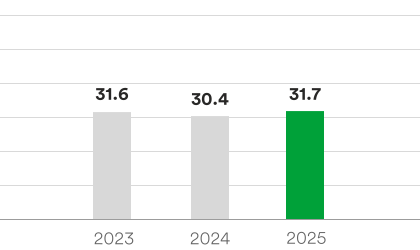
In 2025, innovation activities were more strongly aligned with specific customer requirements and the objective of rapid implementation. In addition, as part of the performance program, production areas received intensive support through a wide range of debottlenecking and process optimization measures. Alongside capacity increases, this led to improved efficiency and quality as well as reduced energy consumption. The key figures for innovation in the 2025 reporting year were as follows: A total of 197 employees worked in the various innovation areas (compared with 205 employees at the end of 2024). Research and development expenditures calculated according to the Frascati method (less grants received) amounted to EUR 31.7 mn (compared with EUR 30.4 mn in 2024). Lenzing’s products and technologies were protected by 944 patents and patent applications (from 140 patent families) in 40 countries and organizations as of the end of 2025. In addition, strategic investments amounting to more than EUR 100 mn at the Austrian sites of Lenzing and Heiligenkreuz were initiated in 2025. This investment package for innovation and sustainability secures the long-term competitiveness and profitability of both sites.
R&D expenditure (after Frascati)
in EUR mn
In 2025, Lenzing was nominated for the Austrian State Prize for Patents in the special “Matilda” category. This award recognizes companies that place particular emphasis on promoting women in innovation. Evaluation criteria include targeted promotion of women, a progressive corporate philosophy, the reduction of role stereotypes and the percentage of women in management positions and in scientific and technical roles. Lenzing’s research department serves as a flagship in terms of DEI (Diversity, Equity and Inclusion). The percentage of women is significantly higher than the Lenzing Group average and within the management team it exceeds 50 percent. The percentage of women in production shift teams is also steadily increasing and female chemical process technicians are being trained as part of the “Women in Technology” project. One metric that is remarkable not only within the Group but also internationally is the percentage of female inventors involved in Lenzing’s patents. This figure stands at 47.5 percent, compared with an average of 8 percent in Austria and 13.2 percent across the EU.
Efficiency enhancement and process optimization
In the Pulp area, the impact of using different wood species on the production process and on product quality was examined with the aim of achieving maximum yield. In addition, numerous studies were conducted in both pulp cooking and pulp bleaching to selectively increase process efficiencies and to reduce both chemical dosages and energy requirements. Process simulations combined with extensive statistical test programs form the basis for increasing yields while maintaining quality parameters at a consistently high level. An important focus was the identification and analysis of various process streams in order to evaluate the potential for producing additional new co-products.
The industrialization of the circular economy formed a further major focus of R&D activities in 2025. The strategic partnership with Södra is being consistently advanced within the EU-funded LIFE TREATS project, with the aim of efficiently processing complex post-consumer textile waste. The quality level required for lyocell fiber production was achieved in pilot campaigns. This is a key prerequisite for the production of lyocell fibers from recycled material on an industrial scale. The strategic partnership with Södra was further deepened in terms of content and expanded operationally: raw material specifications for the sorting of used textiles were developed and separation technologies for elastane and polyamide fibers were improved. Thanks to the further development of specialized analytical methods (including for contaminant characterization), it is now possible to define contaminants more precisely and refine pulp specifications. In parallel, the IP portfolio in textile recycling was expanded to safeguard competitive advantage. Moreover, the textile recycling network was further developed in order to jointly address this complex topic.
In parallel with textile recycling, numerous activities were also carried out to obtain pulps for fiber production from alternative raw material sources, such as agricultural waste. As with textile recycling, Lenzing relies on intensive cooperation to investigate the suitability of such pulps for the fiber production process.
Several projects also focused on the use of a wide range of membrane technologies for recovery processes as well as wastewater treatment. Membrane technologies not only represent highly selective alternatives to existing technologies but also contribute to a significant reduction in the carbon footprint.
As e-mobility continues to expand, a significant medium-term oversupply of sodium sulfate (one of the by-products of the viscose process) is expected, driven by lithium extraction as well as battery production and battery recycling. Lenzing is working together with partners in a development project on the electrochemical splitting of sodium sulfate to produce caustic soda and sulfuric acid, both of which are essential chemicals for the manufacture of viscose fibers.
Innovative new fiber types and technologies
As part of various projects aimed at the production of innovative specialty fibers, intensive work was carried out in close collaboration with other innovation areas on the development of specialized spinnerets. This supports the premiumisation pillar in the corporate strategy to focus even more strongly in the future on the production of specialty fibers and their applications.
The development of specific fiber types and their use in selected applications formed a key focus within innovation for nonwoven fibers. These developments were carried out in close coordination with our direct customers as well as their customers in order to ensure market readiness already during the development process.
One of the newly developed fiber types is a lyocell fiber with a flat cross-section, rather than the usual round cross-section. The flat cross-section features new and different properties, such as improved liquid transport. The fiber was presented in 2025 at the Global Fiber Congress in Dornbirn. A number of customer enquiries already indicate strong market interest. In 2025, the production rate of this flat fiber was increased by 30 percent compared with the previous year, making the fibers even more attractive for customer product developments.
In a partnership with adidas, it was demonstrated that products made from lyocell fibers (similar to cotton) can be chemically recycled back into lyocell fibers. Fabrics made of 100 percent lyocell were dissolved, synthetic dyes removed and new fibers produced – without bleaching and while retaining the natural, undyed fiber color. These fibers were spun into yarn and processed into a prototype sweater – simple, natural and aligned with circular economy principles.
Developments also continued in 2025 for the TENCEL™ Luxe Filament product and LENZING™ Nonwoven Technology (LNT), both of which are based on the lyocell process. In addition to ongoing technological advancement with the aim of industrial-scale facilities, market development formed a key focus. LNT material was used for the first time in a commercially available product in 2025. Market response and real-world performance are currently being evaluated. As a consequence, the LNT application pipeline now ranges from products already available on the market to new applications that were successfully tested for the first time in 2025.
In addition to bilateral cooperation with promising customers, a significant part of the development work on TENCEL™ Luxe Filament is also conducted in the context of EU projects. The CELLFIL project launched in 2024 focuses on the production of lyocell filaments and their applications. Lenzing is one of the main partners here and also serves as scientific coordinator. Lyocell filament is also represented as one of the use cases in the ESCIB project, which is developing new methods for sustainability assessment (especially for biobased and circular materials).
A further new technology in which Lenzing is involved is the novel fiber production process developed by Swedish cellulose fiber company TreeToTextile AB. Lenzing acquired a non-controlling interest in this company in 2024 and established a strategic partnership to develop next-generation cellulose fibers. The award-winning technology and production process developed by TreeToTextile, which significantly reduce environmental impact, are fully aligned with Lenzing’s commitment to sustainability.
In February 2026, Lenzing acquired a controlling majority and became majority owner of TreeToTextile AB. With the majority acquisition, Lenzing underscores its commitment to consistently advancing its premiumisation strategy and further expanding its leadership position in the global specialty fiber market. The transaction enables an accelerated scaling of the new technology. Lenzing plans a significant increase in production output at the existing demonstration plant in Nymölla, Sweden, as well as the preparation of the first industrial‑scale facility.
Artificial intelligence (AI) is playing an increasingly important role for the Lenzing Group, including in innovation projects. Lenzing already successfully deploys AI systems in its production facilities. In 2025, AI-based solutions were also introduced to accelerate and automate workflows in laboratories.