Business Performance of the Lenzing Group
The Lenzing Group’s business performance was negatively impacted by several external factors, such as international tariff measures and the resultant uncertainty in the textile value chain as well as subdued demand and falling market prices, particularly in the second half of 2025. Despite these challenges, the company achieved higher EBITDA in 2025 than in the previous year and an improvement in its free cash flow, largely thanks to its comprehensive performance program to increase profitability and optimize cash management. In addition to the effects of the performance program, the sale of surplus EU emission allowances and sales revenues from pulp sales on the external market also contributed positively to the earnings performance.1
Market prices for staple fibers were under pressure in 2025 due to subdued demand, especially in the second half of the year, and prices for dissolving wood pulp also decreased significantly over the course of the year. This, in combination with continued high costs for raw materials, energy and logistics, further slowed the Lenzing Group’s business performance. In response to this challenging market environment, Lenzing adjusted its production capacities in order to improve the trend in its trading working capital and strengthen its cash flow.
The Lenzing Group’s earnings performance was also shaped by an impairment loss, which had a negative impact on earnings before interest and tax (EBIT). Strategic options are being evaluated for the site in Indonesia, including a possible sale. In this context, non-cash impairments of long-term assets, in particular property, plant and equipment, amounting to EUR 82 mn were recognized. The impairment losses affected EBIT but had no impact on EBITDA.
In 2025, Lenzing announced the following changes on the Managing Board. Chief Transformation Officer Walter Bickel stepped down from his temporary mandate early, at the end of March 2025. Following the departure of Walter Bickel, Georg Kasperkovitz joined the Managing Board of Lenzing AG as Chief Operations Officer on June 1, 2025.
CEO Rohit Aggarwal stepped down from his Managing Board role for personal reasons with effect from January 31, 2026. Since Rohit Aggarwal’s departure, the company has been managed by a three-member Managing Board team consisting of CFO Mathias Breuer, COO Georg Kasperkovitz and CPO/CTO Christian Skilich. In connection with Rohit Aggarwal’s departure, an Executive Committee was also established to further develop the organization and drive the premiumisation strategy. This body consists of the three Managing Board members and the three top commercial executives for textile and nonwoven fibers as well as dissolving wood pulp. The Supervisory Board has already initiated the process to appoint a successor to the CEO role and will provide information on the new appointment in due course. To ensure a seamless transition, Rohit Aggarwal will support Lenzing AG as an adviser until the end of September 2026.
Mathias Breuer, most recently responsible as Senior Vice President for the performance program, was appointed by the Supervisory Board as the new CFO with effect from January 1, 2026. He succeeds Nico Reiner, who did not extend his mandate, which expired at the end of 2025. The Supervisory Board has also extended, ahead of schedule, the Managing Board mandate of Christian Skilich, who has been a member of the Lenzing Management Board since June 2020 and currently holds the positions of Chief Pulp and Chief Technology Officer, until May 31, 2029.
The Managing Board of the Lenzing Group continues to work consistently on the transformation of the company in order to strengthen its profitability, resilience and agility. A key element of this transformation is the holistic performance program, which primarily aims to improve EBITDA and generate free cash flow through higher profitability, rigorous cost management and targeted trading working capital management.
As a consequence, Lenzing is continuously implementing measures to optimize structural, process and personnel costs, which also contribute to increasing revenue and margins. In the 2025 financial year, cost savings of more than EUR 200 mn were realized, compared with EUR 130 mn in the previous year.
Moreover, in the third quarter of 2025 the Managing Board decided on further measures to sustainably strengthen competitiveness. These include a reduction of around 600 positions in Austria, mainly in administrative functions. The associated annual savings of around EUR 45 mn are expected to be fully effective by the end of 2027 at the latest.
In parallel, the focus is on sustainable cost-saving effects through operational excellence and energy optimization at all production sites. In particular, the Lenzing Group is realizing strategic investments of more than EUR 100 mn in the Austrian sites at Lenzing and Heiligenkreuz in order to secure their long-term competitiveness.
To strengthen sales and revenue growth, new customers were acquired for key products, and expansion into previously smaller markets was stepped up. At the same time, Lenzing is strengthening its international presence in key high-margin markets in North America and Asia. In procurement, too, operational and strategic measures have delivered successes in achieving cost savings.
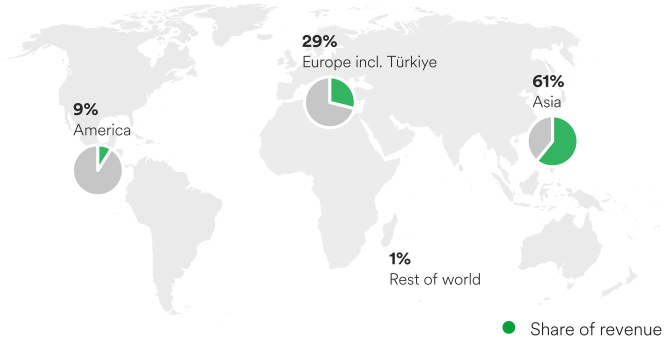
The Lenzing Group’s revenue decreased slightly by 2.3 percent year-on-year to EUR 2.6 bn in 2025. This decline is primarily due to reduced fiber sales volumes and lower prices for fibers and pulp. In 2025, 61 percent of the Lenzing Group’s external revenue was generated in Asia, 29 percent in Europe including Turkey, 9 percent in the Americas and 1 percent in other regions. The distribution of revenue by region illustrates the global footprint of the Lenzing Group.
Revenue split by region
The positive effects of the performance program were an important factor driving the operating earnings trend. Earnings before interest, tax, depreciation and amortization (EBITDA) grew by 4.5 percent year-on-year from EUR 395.4 mn in 2024 to EUR 413 mn and include positive one-off effects from the sale of surplus EU emission allowances amounting to EUR 45.1 mn. The EBITDA margin increased from 14.8 to 15.9 percent.
The operating result (EBIT) amounted to EUR 17.6 mn (compared with EUR 88.5 mn in 2024) and the EBIT margin was 0.7 percent (compared with 3.3 percent in the previous year). EBIT was significantly influenced by the impairment of non-current assets at the Indonesian production site, amounting to EUR 82 mn. For a detailed description, please refer to note 10 of the consolidated financial statements, section ‘Impairment Test of the CGU Fiber Site Indonesia”.
The result before tax (EBT) amounted to minus EUR 122.5 mn (compared with minus EUR 42 mn in 2024).
The income tax expense amounted to EUR 12.7 mn in 2025 (compared with EUR 96.3 mn in 2024) and was influenced in particular by the value adjustment of tax assets of individual Group companies and currency effects from the translation of tax items from the local currency to the functional currency.2
The result after tax improved slightly to minus EUR 135.2 mn (compared with minus EUR 138.3 mn in the previous year).
The improved cash flow from operating activities amounted to EUR 419.7 mn in the reporting year (compared with EUR 395 mn3 in 2024). Cash flow from investing activities amounted to minus EUR 146.9 mn (compared with minus EUR 152.1 mn3 in 2024). Cash flow from financing activities improved significantly to minus EUR 16.4 mn compared with minus EUR 535.4 mn3 in the previous year. The increase is mainly due to the refinancing measures realized in the reporting period.
In May 2025, syndicated financing of EUR 545 mn was arranged, consisting of a bullet loan of EUR 355 mn with a term of three years and a revolving line of credit of EUR 190 mn with a term of three years and extension options of two years in total. A new hybrid bond in a volume of EUR 500 mn was successfully placed in July 2025. The offer was aimed at existing investors of the hybrid bond issued in 2020 as part of an exchange offer as well as new investors. In September 2025, Lenzing also exercised its contractual right to terminate the remaining portion of the hybrid bond 2020 and redeemed it at par plus accrued interest. These measures highlight the strategic and proactive focus on a sustainable capital structure and on strengthening the company’s financial resilience.
Free cash flow showed a positive trend with an increase to EUR 173.9 mn (compared with EUR 169.4 mn3 in the previous year). Unlevered free cash flow rose to EUR 279.3 mn (compared with EUR 244.6 mn in the same period of the previous year). Trading working capital decreased by 21.6 percent to EUR 453.4 mn.
Liquid assets (including liquid bills) increased by 53 percent compared to December 31, 2024, to EUR 690.9 mn as of December 31, 2025, mainly due to the syndicated financing agreed in May 2025, operating activities and targeted management of trading working capital.
Capital expenditures for intangible assets, property, plant and equipment, and biological assets (CAPEX) amounted to EUR 141.1 mn in 2025 (compared with EUR 153.8 mn in 2024), reflecting a reduction in the level of investment activities.
Total assets decreased by 7.4 percent compared with December 31, 2024, to EUR 4.6 bn as of December 31, 2025. Adjusted equity reduced from EUR 1.7 bn to EUR 1.4 bn. The adjusted equity ratio stood at 29.6 percent as of December 31, 2025, compared with 34.7 percent in the previous year. Net financial debt decreased by 11.9 percent to EUR 1.35 bn as of the reporting date. Net gearing increased to 99 percent (compared with 88.8 percent as of December 31, 2024).
The details of the revenue and earnings trends in the year under review are as follows:
|
|
|
Change |
|||
|---|---|---|---|---|---|---|
|
2025 |
2024 |
Absolute |
Relative |
||
Revenue |
2,602.4 |
2,663.9 |
(61.5) |
(2.3)% |
||
Cost of sales |
(2,264.1) |
(2,155.8) |
(108.2) |
(5.0)% |
||
Gross profit |
338.4 |
508.1 |
(169.7) |
(33.4)% |
||
|
|
|
|
|
||
Other operating income |
133.6 |
61.8 |
71.8 |
116.3% |
||
Selling expenses |
(280.9) |
(300.5) |
19.6 |
6.5% |
||
Administrative expenses |
(126.3) |
(146.7) |
20.4 |
13.9% |
||
Research and development expenses |
(29.1) |
(29.2) |
0.0 |
0.0% |
||
Other operating expenses |
(17.9) |
(4.9) |
(13.0) |
(262.2)% |
||
EBIT |
17.6 |
88.5 |
(70.9) |
(80.1)% |
||
|
|
|
|
|
||
Financial result |
(140.1) |
(130.5) |
(9.6) |
(7.3)% |
||
EBT |
(122.5) |
(42.0) |
(80.5) |
(191.6)% |
||
|
|
|
|
|
||
Income tax expense |
(12.7) |
(96.3) |
83.5 |
86.8% |
||
Net profit/loss after tax |
(135.2) |
(138.3) |
3.1 |
2.2% |
||
|
||||||
1The key figures are explained in more detail in the section “Appendix: Notes on the Financial Performance Indicators of the Lenzing Group”.
2Predominant currency of the primary economic environment of a subsidiary.
3In order to improve the transparency and comparability of the financial performance indicators, the Lenzing Group has utilized the options available under IAS 7 and adjusted the presentation of the cash flow statement. The new structure starts with EBT and enables the calculation of unlevered free cash flow, which serves as a key performance indicator in addition to free cash flow as part of the performance program. This adjustment is in line with standard market reporting practices and improves the informative value of the cash flow statement for both internal and external stakeholders. This change in presentation was made retrospectively in accordance with IAS 8. A reconciliation to the adjusted figures for the comparative period can be found in note 2 of the consolidated financial statements.